
As the world’s largest solar-powered aircraft looks to set off on its most ambitious mission to date – a trip to circumnavigate the globe – Aerospace Global News caught up with Robert Miller PhD, CEO and co-founder of Skydweller Aero, to find out more about the impetus behind the initiative.
Read the complete article at – Ultimate endurance: achieving solar-powered perpetual flight (aerospaceglobalnews.com)
Nik Coleman of Coleman Television produces “History’s Greatest Aircraft,” a series that looks at some of the most impressive technical marvels of engineering to have ever taken to the sky. Each episode delves into a different aircraft to analyze its service history and recount some of its most legendary stories.
Skydweller Aero is honored to have caught the attention of this award winning program’s creator during the 2024 Farnborough Air Show, and to share our story with him and his audience.

Seeing Skydweller in flight for the first time, some southern Mississippi folks enjoying themselves on the bayou made this video.
Even without a video, seeing Skydweller in flight for the first time is likely something they will never forget.
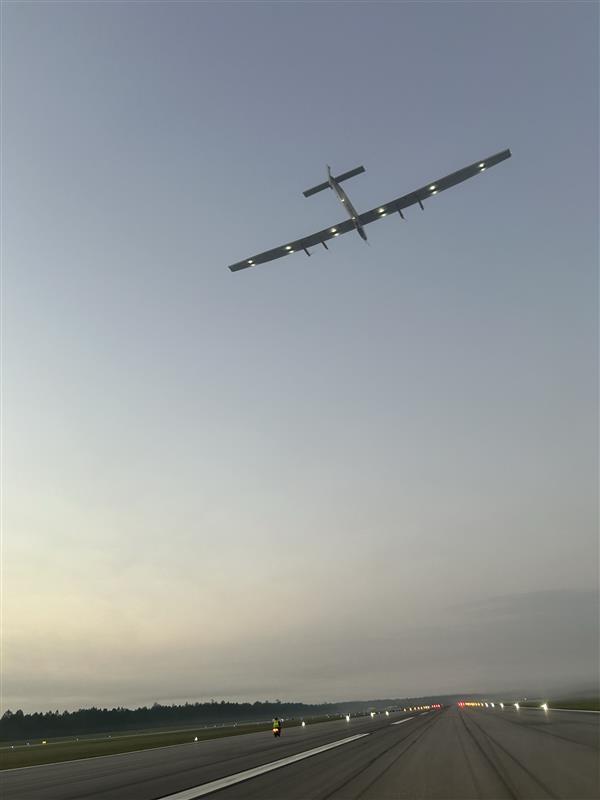
Skydweller is the world’s largest uncrewed, all-carbon fiber aircraft with a wingspan greater than a 747 and weigh about the same as a Ford F-150, capable of performing extreme endurance flights with heavy, powerful payloads. Skydwellers will be used for ultra-long duration missions such as providing exclusive economic zone enforcement, monitoring naval activity, and detecting drug smugglers and pirates at sea, and will accomplish these missions with zero carbon footprint.

Vetter Formerly Served as the Company’s Chief Engineer
20 August 2024 – Skydweller Aero, Inc. is excited to announce Travis Vetter, its Chief Engineer, has been appointed Chief Technology Officer (CTO). In his new position, Travis will spearhead Skydweller’s strategic utilization of innovative technologies to maintain competitiveness and achieve the company’s objectives.
“Travis brings a wealth of experience and a forward-thinking approach to technology that perfectly aligns with our mission to innovate and lead the autonomous solar aircraft industry. His leadership will play a pivotal role in advancing our technological roadmap, improving our product offerings, and ensuring our position as a frontrunner in industry advancements,” said Dr. Robert Miller, Chief Executive Officer and co-founder of Skydweller Aero. “I am confident that under his guidance, our technology team will continue to push boundaries, deliver exceptional value to our customers and partners.”
Travis, a longstanding member of Skydweller’s leadership team, previously served as a Chief Engineer for Special Programs at Northrop Grumman. In this role, he provided technical guidance to hundreds of engineers and oversaw millions of dollars in annual revenue. Before that, Travis held key technical positions at the Defense Advanced Research Projects Agency (DARPA), where he led various programs including the Tern program as the Air Vehicle, VMS, and Flight Controls lead, as well as serving as the Guidance Navigation & Control IPT Special Projects lead and Aeroelastic Controls lead for undisclosed projects.
Travis brings extensive expertise in aircraft design, UAV flight control, aeroelastic systems control, vehicle management systems, and mission systems integration. He holds two Bachelor’s degrees and a Master’s degree in Mechanical and Aeronautical Engineering from the University of California.

Complete article here: Skydweller outlines vision for perpetual, autonomous solar flight (simpliflying.com)
At the Farnborough International Airshow last week, Skydweller Aero revealed a significant milestone: the successful completion of the first autonomous flight by a large-scale solar-powered aircraft in the United States.
This achievement marks a step towards the company’s ambitious goal of continuous around-the-world flight, potentially revolutionising long-duration aerial missions.
Barry Matsumori, President and Chief Operating Officer of Skydweller Aero, summarised the company’s ambitious vision:
“We’re talking about going around the world non-stop, solar, so all green, and doing it uncrewed, unmanned, autonomously. Has anyone done that, all that combination of capabilities? The answer is no, not yet.”
Solar-powered aircraft pursues nonstop flight around the world
Farnborough Air Show 2024 – Day Three (aerosociety.com)
Oklahoma City-based Skydweller Aero, operator of the largest solar aircraft, is hoping to fly around the world nonstop, with no fuel, and no remote pilot. At a briefing on the third day of the air show, Skydweller President and COO, Barry Matusmori who is an ex-SpaceX exec, announced that after its aircraft – which has a wingspan larger than a Boeing 747 – completed the first entirely autonomous solar-powered flight, including take-off, flying and landing, in April, and has flown continuously for a maximum of five days and nights within the US, it is now seeking to complete a far longer mission to circumnavigate the globe. Matusmori said a route and date would be announced soon, however, the mission would validate the technology’s goal of staying aloft for 90 days or more.
The aircraft is designed to support several long-duration missions that have previously required a fleet of conventional aircraft, such as ISR in conflict zones, surveilling naval activity in contested waters, wildfire monitoring, and even border control. “Think of it as a very high-altitude base station that isn’t sitting on the ground, but sitting up in the air,” Matusmori said at the briefing. Furthermore, because it will be able to complete long stints without being refuelled, and instead being powered by solar cells that generate about 200,000 watts of electricity, the company claims the technology will be up to 100 times less expensive than conventional aircraft and will leave zero carbon footprint.
“The thing that we want to emphasise is that green matters, and the ability to be sustainable and protect the environment is an important aspect of what we’re doing,” said Matusmori. “If we can help push the notion that you can get to all parts of the Earth with a solar power plane, that’s a very big deal.”
The company was founded in 2017 and invested in by Leonardo. In 2019, Skydweller bought Solar Impulse 2 (SI2), an aircraft that completed the longest continuous solar-powered flight to date. However, all that remains from SI2 is its airframe – everything else has changed.
Matsumori explained that the unique part of Skydweller’s goal is that, while these types of missions have been completed by other companies before, whether flying an uncrewed, solar-powered, or completely unrefuelled aircraft, no one has accomplished all of those capabilities at once. Matsumori added: “The challenge is to put it all together and make it work so that it can fly continuously around the world. But that is what we are going to accomplish.”

Complete article here: Skydweller on mission to fly uncrewed solar aircraft autonomously nonstop around the world – Futurride
Skydweller Aero landed at the 2024 Farnborough International Airshow this week with an update on its progress toward its established goal of flying its uncrewed solar aircraft autonomously nonstop around the world. It exhibited with Kallman Worldwide, Inc. in its USA Pavilion, and President & COO Barry Matusmori presented on the company’s journey, the aircraft’s capabilities, and an update on aircraft flight operations. Before joining Skydweller, Matusmori was the COO of Impulse Space and had executive leadership roles at SpaceX and Virgin Orbit.
Others have achieved elements of the company’s goal of autonomous, nonstop solar power around the world flight, “but no one has ever even attempted what we intend to do,” posted Greg Caires, Communications Director for Skydweller Aero, on LinkedIn. He cited Lucky Lady II, a U.S. Air Force Boeing B-50 Superfortress that became the first airplane to circle the world nonstop in 1949, Scaled Composites’ Voyager, Virgin Atlantic’s GlobalFlyer, and even Solar Impulse 2 that Skydweller purchased in 2019.
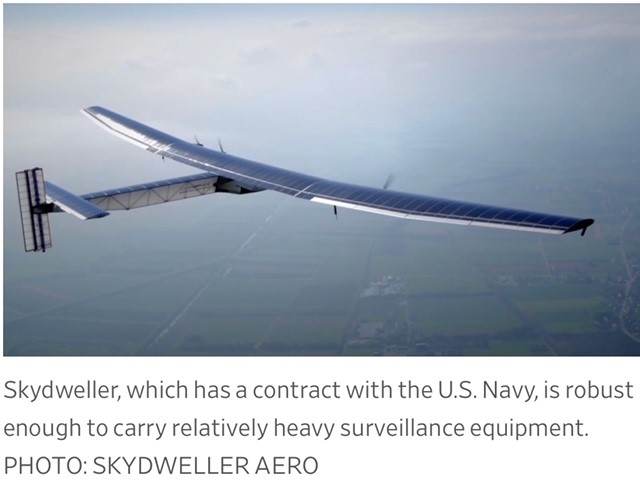
The complete article can be accessed here: Solar-Powered Planes Take Flight
Excerpt from the Wall Street Journal:
THE FUTURE OF EVERYTHING – Solar-Powered Planes Take Flight
The light, uncrewed aircraft could provide surveillance and telecommunications that balloons and satellites can’t—and stay aloft for months
By Phred Dvorak, Wall Street Journal
June 10, 2024 at 9:00 pm ET
Imagine airplanes powered only by energy from the sun, some so light they can be launched from the ground by hand, others gathered in giant “parking lots” in the stratosphere.
Those are the types of aircraft being developed now that are bringing the dream of solar- powered flight closer to reality, with planes that act very differently from the jetliners of today.
Solar-powered planes won’t be flying people to their next vacation spot anytime soon. But these prototypes, most of which operate without humans, could lead to new alternatives for aerial surveillance on high-risk missions and emergency telecommunications in disaster zones, industry executives say. Aviation giants, telecommunication companies, venture investors and military agencies are already spending millions of dollars developing the planes and their technologies.
“It’s like in the early days of aviation” as companies, governments and investors try to figure out what these planes can do and what could be economically viable, says Eric Raymond, a solar-aircraft designer and glider pilot who started experimenting with solar-powered flight in 1979. “The potential is there, I do believe in it after all these years.”
Solar aircraft typically soak up the sun’s energy via panels that cover the wings—and sometimes the body, sides and tail as well. The advantage of solar power is that it is free and emissionless—much more environmentally friendly than burning jet fuel. A solar plane never needs refueling, and in theory it can stay in the air as long as the sun is shining. That brings perpetual flight within reach, if the solar is paired with batteries that charge during the day and power the aircraft and its payload at night.
Advances in battery technology and cost have finally made it feasible to power a solar plane for longer distances or through the night, solar-aircraft executives say, albeit with much less power than jet fuel, pound for pound. That means today’s solar aircraft are extremely lightweight and slow. Many fly around the speed of a slow car. They have trouble withstanding bad weather. Most can’t carry heavy loads.
The planes have some advantages over current aircraft used for services like surveillance.
Most of the companies trying to commercialize solar planes are building aircraft that are lightweight, autonomous and can fly at altitudes and for lengths of time that humans can’t tolerate. Unlike balloons, solar planes are steerable, a big advantage for monitoring a target on the ground or providing telecom coverage without being blown off course. They are also cheaper and closer to Earth than satellites, putting them in a sweet spot for services that can’t currently be offered by either, executives in charge of solar-aircraft projects say.
The planes can capture higher resolution photos or video than satellites, or deliver broadband internet from the air, another thing satellites can’t do. Executives envision programming them to fly to the other side of the globe on surveillance missions that last months, making them a safer and longer-term alternative to monitoring by piloted planes. Solar aircraft could be sent to disaster zones to provide emergency telecommunications then flown away when they are no longer needed.
Aerospace engineer and military drone designer Robert Miller says he first became interested in solar-powered airplanes several years ago, when the U.S. Defense Advanced Research Projects Agency, or Darpa, asked him to come up with a surveillance craft that could locate Joseph Kony, an African warlord accused of kidnapping and killing thousands of people in northern Uganda.
To do that, Miller figured he would need an aircraft that could travel long distances to a specified location and hang around for weeks at a time—something satellites in orbit can’t do—carrying a special radar that can track movement under the dense jungle canopy where Kony was believed to be hiding.
He landed on the Solar Impulse 2, a Swiss single-seater solar-powered plane with a wingspan as broad as a jumbo jet, which had recently become the first to circumnavigate the globe in 2016.
Miller started a company, bought the Solar Impulse 2 and retrofitted it to fly without humans, snagging a $5 million contract from the U.S. Navy along the way. The aircraft, renamed Skydweller, is flying test flights out of Mississippi, and the company is building a second that Miller hopes to have ready for delivery next year. It is heavier and can carry more than most of the other solar-plane prototypes, and flies at the same altitude as commercial airplanes.
One of the biggest challenges, Miller says, is ensuring the plane is robust enough to withstand winds and weather while it stays aloft for a targeted 90 days at a time.
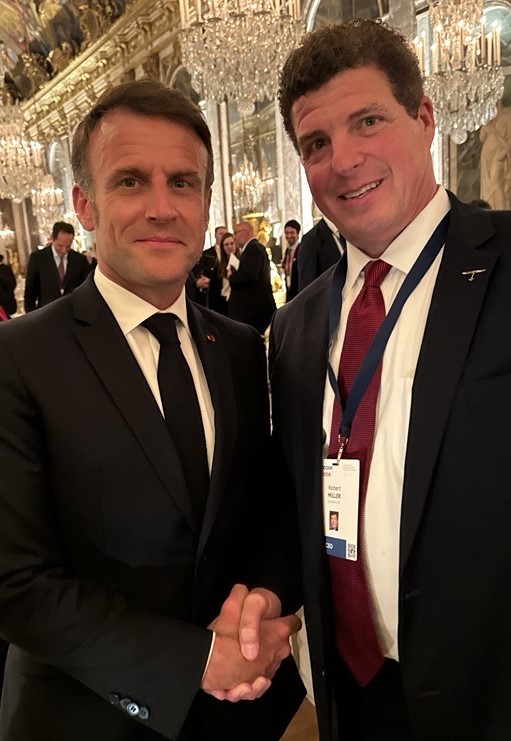
Oklahoma City, OK (May 13, 2024) — Skydweller Aero, Inc., Founder and CEO, Dr. Robert H. Miller met with French President Emmanuel Macron and his Ministers on May 13th to discuss how the company’s large capacity, autonomous solar-powered aircraft can perform civil, commercial and defense-related missions for the French government working with French industries.
The meeting occurred at the Château de Versailles during the 2024 Choose France summit, the country’s annual exclusive flagship business and strategy conference. President Macron personally invited Dr. Miller to attend the event.
“I am honored to have had the opportunity to speak with President Macron and his Ministers. I look forward to pursuing follow-on discussions with French government and industry officials about strategic cooperation between Skydweller Aero and France’s public sector and high-tech industries,” Dr. Miller said. “From monitoring illegal activities offshore, to mitigating natural disasters within the homeland, the innovative capabilities of our aircraft can help protect France, the French people, and its global interests.”
Established in 2018, Choose France promotes the country’s economic attractiveness and encourages international investment in and cooperation with France by gathering hundreds of leaders from the world’s largest multinational corporations. Since 2018, the event has generated more than 50 billion Euro in direct foreign investment.
About Skydweller Aero Inc.
Skydweller Aero Inc. is a pioneering transatlantic aerospace company developing and manufacturing a fleet of large capacity solar-powered autonomous aircraft capable of achieving perpetual flight while carrying a tremendous amount of payload. Our aircraft are manufactured from carbon-fiber – each with a wingspan similar to a 747 jumbo jet – and because they are solar powered, they are inexpensive to operate and maintain and feature zero carbon footprint.
With a flexible payload system, including communications relay, 4G/5G cellular, day/night full motion video, satellite communication, imaging radar, and more, these aircraft will be used for long duration missions such as providing continuous coverage above war zones, surveilling naval activity in contested waters, and detecting drug smugglers and pirates at sea. They will enhance commercial and government telecommunication, geospatial, meteorological and emergency operation efforts around the world, allowing customers to operate persistently in more challenging areas for longer durations, while reducing environmental impact.
Skydweller Aero Inc. has World and US headquarters in Oklahoma City and European offices headquartered in Spain.
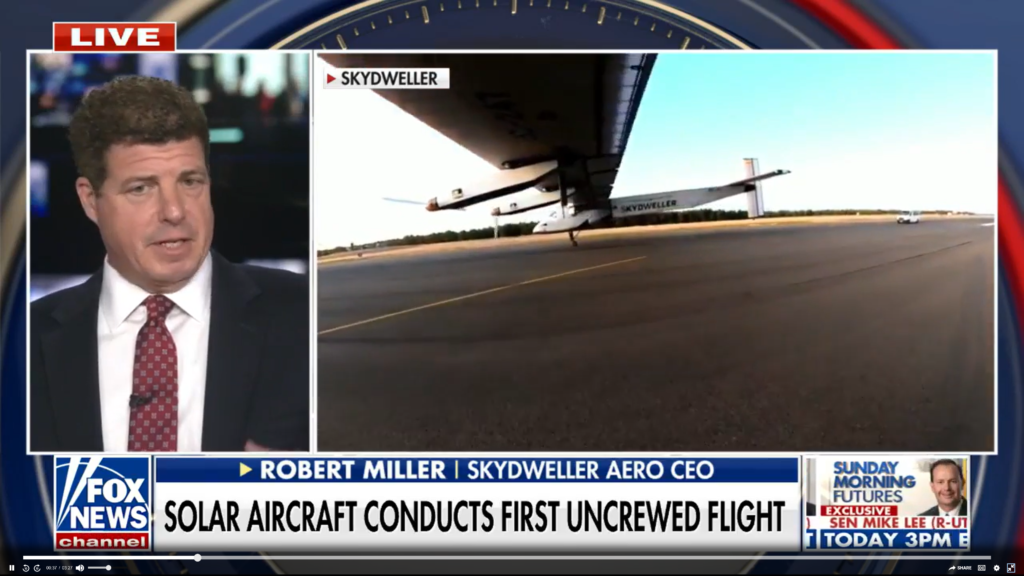
Fox News Live interview of Skydweller CEO Robert Miller: Solar-powered, uncrewed flights are the ‘future’ of aviation
April 21, 2024