
Skydweller Aero is proud to be featured in Popular Mechanics for our groundbreaking work in solar-powered, autonomous flight. The article spotlights Skydweller — the largest solar-powered aircraft in the world — and its ability to remain airborne for months at a time without refueling.
With a 236-foot wingspan covered in 17,000 solar cells, a 1,400-pound battery system, and advanced quadruple-redundant flight software, Skydweller is built for unmatched persistence and reliability. Operating at altitudes up to 35,000 feet, our platform can loiter for extended periods, making it ideal for maritime surveillance, disaster response, and other long-endurance missions.
“This is a true, world-changing first in the aerospace industry,” said Robert Miller, CEO and Co-Founder of Skydweller Aero. “We are applying cutting-edge, 21st-century materials science, artificial intelligence, and software development to an industry that has spent more than 100 years building piloted, combustion-based aircraft.”
The feature notes Skydweller’s role in advancing both sustainable aviation and autonomous aerial capabilities — combining carbon-fiber construction, solar energy, and resilient systems to redefine what’s possible in aerospace.
📖 Read the full Popular Mechanics article here: This Plane Is Bigger than a 747. It Can Fly for Months on Its Own.
Patuxent River, Md. — Skydweller Aero, in partnership with the U.S. Navy’s Naval Air Warfare Center Aircraft Division (NAWCAD), has achieved a major milestone in the evolution of long-endurance, solar-powered unmanned flight.
During a nonstop 73-hour mission from Stennis International Airport in Mississippi, Skydweller demonstrated the ability to sustain flight entirely on solar power for multiple days, validating its potential as a transformative platform for maritime intelligence, surveillance, and reconnaissance (ISR).
“This demonstration is a prime example of how NAWCAD partners with industry to deliver what the fleet needs,” said Rear Adm. Todd Evans, NAWCAD Commander. “It also reflects the technical depth of our workforce and our ability to translate ideas into capability.”
The flight showcased:
-
Positive energy balance—powering the aircraft entirely from solar energy over multiple days
-
Reliable autonomous operations in real-world conditions
-
Seamless communications for mission-critical data transfer
-
Resilience in turbulent weather
Bill Macchione, NAWCAD’s Special Purpose UAS lead, emphasized the strategic value: “Integrating Skydweller into the Navy’s ISR architecture creates a layered and resilient network that maximizes the capabilities of all our assets.”
A Persistent Eye in the Sky
Skydweller’s unmatched endurance enables persistent, wide-area surveillance over vast ocean and coastal regions. This capability frees other platforms to focus on specialized missions, such as rapid response and advanced sensor deployment.
The Navy began testing Skydweller’s solar-powered UAS in 2020 to address U.S. Southern Command operational challenges, including maritime security, counter-narcotics, and border protection. Further testing is planned for later this summer in the SOUTHCOM area of responsibility.
With a 236-foot wingspan, 17,000 solar cells, and the ability to remain airborne for months at a time, Skydweller Aero is redefining what’s possible in clean, autonomous, and persistent flight.
📖 Read the full Navy press release here

Skydweller Aero’s vision for long-endurance, solar-powered flight has been featured in Aerospace America, the flagship magazine of the American Institute of Aeronautics and Astronautics (AIAA). The in-depth profile, written by Keith Button, explores the engineering innovations, operational milestones, and mission potential behind our groundbreaking platform.
With a wingspan larger than a Boeing 747 and a weight of just 2,500 kilograms, Skydweller is designed to stay airborne for up to 90 consecutive days — unlocking persistent, low-cost, autonomous surveillance for defense, security, and humanitarian missions.
The article highlights the core challenges of “perpetual flight” — from mitigating turbulence-induced aeroelasticity to building quadruple-redundant systems that keep the aircraft operational through unexpected failures. Our engineering team has developed advanced flight control software, integrated weather prediction and avoidance tools, and designed structural safeguards to ensure mission reliability.
“If you want to fly for 30 or 60 days, things are going to go wrong,” CEO Robert Miller told Aerospace America. “Making an aircraft fly by itself is not that hard. It’s making it fly when not one, not two, but three things go wrong — and you still bring it home.”
From its origins as the piloted Solar Impulse 2 to its transformation into an autonomous, payload-capable surveillance platform, Skydweller represents a new class of aircraft — one that merges renewable energy, aerospace resilience, and operational persistence.
📖 Read the full Aerospace America article: Building toward (almost) perpetual flight – Aerospace America
Robert Miller was a featured guest on the RADICL Defense Industrial Base (DIB) Innovators podcast recently. In an insightful conversation with host Dave Graff, Robert delved into how Skydweller Aero is revolutionizing military surveillance and persistent Intelligence, Surveillance, and Reconnaissance (ISR) with our groundbreaking solar-powered aircraft.
The Skydweller Advantage: From Vision to Reality
During the podcast, Robert highlighted how we’ve taken the historic Solar Impulse 2 aircraft and transformed it into a fully autonomous, unmanned warfare platform. The Skydweller aircraft, with its massive 236-foot wingspan, is designed for continuous flight, addressing a critical capability gap for missions that extend beyond the 1,500-nautical-mile range of current systems. This isn’t just about a technical demonstration; it’s about delivering a genuine, battle-tested operational capability.
A key focus of the discussion was the operational and cost benefits of our platform. Robert explained that by leveraging solar energy, Skydweller offers a significant cost advantage, with maintenance expenses comparable to those of a small general aviation aircraft, not a conventional military asset. This low operational cost, combined with the ability to stay airborne for weeks at a time, represents a paradigm shift in how long-duration missions are conducted.
Navigating Challenges with Innovation
Robert also shared how our team is tackling complex challenges head-on. He discussed the strategic use of advanced weather prediction and autonomous mission planning, which enables the aircraft to navigate environmental hazards by employing mathematical models similar to those used for avoiding enemy radar. He also touched upon the platform’s potential for electronic warfare, noting that the Skydweller’s substantial energy storage capacity can support powerful apertures.
A particularly compelling part of the interview was Robert’s emphasis on the distinction between a “flashy demonstration” and a “real operational capability.” Skydweller has secured airworthiness certifications from European authorities, the FAA, and NAVAIR and is already flying operational missions for SOUTHCOM, demonstrating its readiness and reliability in real-world scenarios.
Shaping the Future of Defense Technology
The conversation covered a range of other topics, including:
- The conversion of the manned Solar Impulse 2 into a fly-by-wire, autonomous unmanned system.
- The survivability advantages of Skydweller’s unique design, such as its reduced heat and acoustic signatures.
- The business challenges of securing private investment while navigating the Department of Defense acquisition process.
Listen to the full podcast to get Robert’s candid insights on the future of defense technology and how Skydweller Aero is leading the way in perpetual flight.
You can watch this episode on YouTube or listen to it via Spotify:
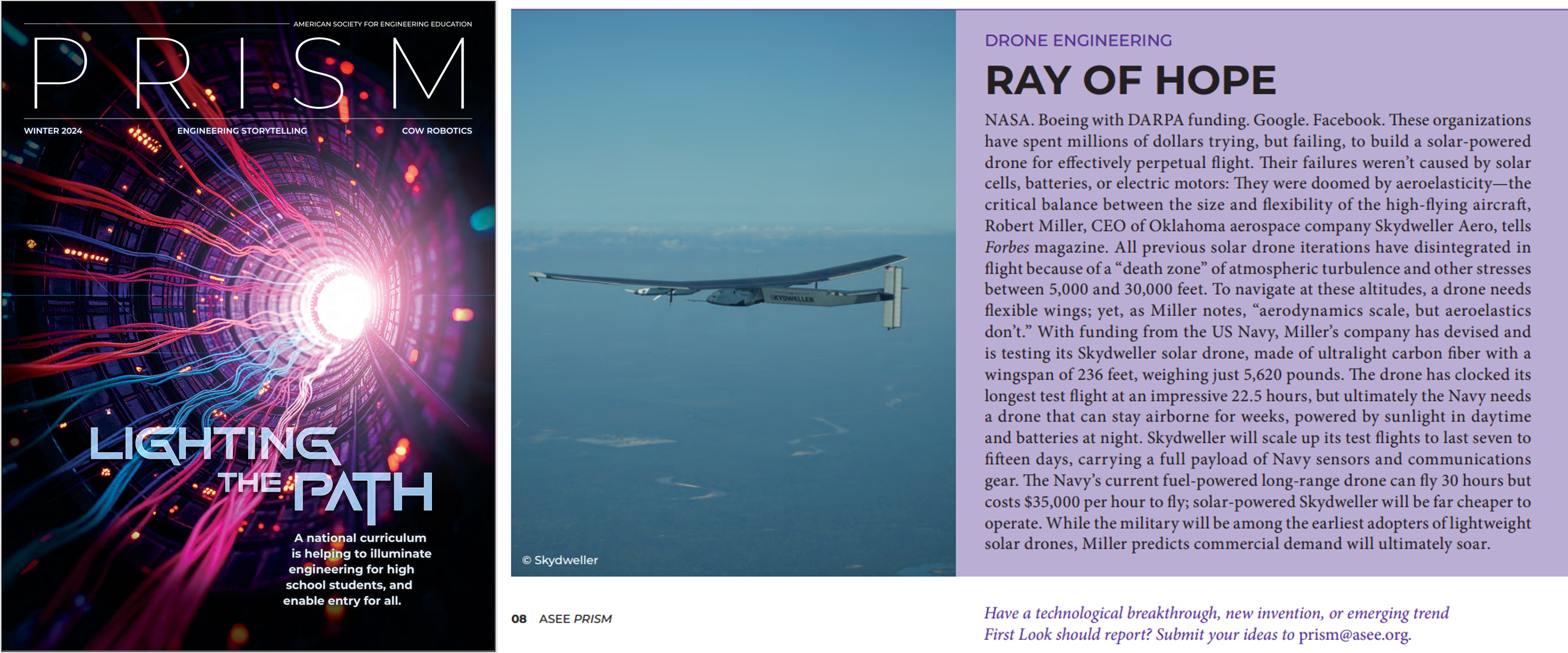
DRONE ENGINEERING
RAY OF HOPE
NASA. Boeing with DARPA funding. Google. Facebook. These organizations have spent millions of dollars trying, but failing, to build a solar-powered drone for effectively perpetual flight. Their failures weren’t caused by solar cells, batteries, or electric motors: They were doomed by aeroelasticity—the critical balance between the size and flexibility of the high-flying aircraft, Robert Miller, CEO of Oklahoma aerospace company Skydweller Aero, tells Forbes magazine. All previous solar drone iterations have disintegrated in flight because of a “death zone” of atmospheric turbulence and other stresses between 5,000 and 30,000 feet. To navigate at these altitudes, a drone needs flexible wings; yet, as Miller notes, “aerodynamics scale, but aeroelastics don’t.” With funding from the US Navy, Miller’s company has devised and is testing its Skydweller solar drone, made of ultralight carbon fiber with a wingspan of 236 feet, weighing just 5,620 pounds. The drone has clocked its longest test flight at an impressive 22.5 hours, but ultimately the Navy needs a drone that can stay airborne for weeks, powered by sunlight in daytime and batteries at night. Skydweller will scale up its test flights to last seven to fifteen days, carrying a full payload of Navy sensors and communications gear. The Navy’s current fuel-powered long-range drone can fly 30 hours but costs $35,000 per hour to fly; solar-powered Skydweller will be far cheaper to operate. While the military will be among the earliest adopters of lightweight solar drones, Miller predicts commercial demand will ultimately soar.

📻 𝗦𝗸𝘆𝗱𝘄𝗲𝗹𝗹𝗲𝗿 𝗢𝗻 𝘁𝗵𝗲 𝗔𝗶𝗿 𝘄𝗶𝘁𝗵 𝗥𝗮𝗱𝗶𝗼 𝗢𝗸𝗹𝗮𝗵𝗼𝗺𝗮❗ 📶
🎙️ 𝘛𝘩𝘦 𝘭𝘰𝘯𝘨-𝘴𝘰𝘶𝘨𝘩𝘵 𝘢𝘷𝘪𝘢𝘵𝘪𝘰𝘯 𝘨𝘰𝘢𝘭 𝘰𝘧 𝘱𝘦𝘳𝘱𝘦𝘵𝘶𝘢𝘭 𝘧𝘭𝘪𝘨𝘩𝘵 𝘢𝘱𝘱𝘦𝘢𝘳𝘴 𝘵𝘰 𝘣𝘦 𝘷𝘦𝘳𝘺 𝘯𝘦𝘢𝘳, 𝘵𝘩𝘢𝘯𝘬𝘴 𝘵𝘰 𝘢𝘯 𝘖𝘬𝘭𝘢𝘩𝘰𝘮𝘢 𝘣𝘢𝘴𝘦𝘥 𝘤𝘰𝘮𝘱𝘢𝘯𝘺, 𝘤𝘰-𝘧𝘰𝘶𝘯𝘥𝘦𝘥 𝘣𝘺 𝘯𝘢𝘵𝘪𝘷𝘦 𝘖𝘬𝘭𝘢𝘩𝘰𝘮𝘢𝘯 𝘙𝘰𝘣𝘦𝘳𝘵 𝘔𝘪𝘭𝘭𝘦𝘳.
🛫 𝘛𝘩𝘦 𝘱𝘭𝘢𝘯𝘦 𝘪𝘴 𝘢 𝘤𝘢𝘳𝘣𝘰𝘯 𝘧𝘪𝘣𝘦𝘳 𝘤𝘳𝘢𝘧𝘵 𝘸𝘪𝘵𝘩 𝘢 𝘸𝘪𝘯𝘨𝘴𝘱𝘢𝘯 𝘰𝘧 𝘢 747 𝘣𝘶𝘵 𝘸𝘦𝘪𝘨𝘩𝘴 𝘵𝘩𝘦 𝘴𝘢𝘮𝘦 𝘢𝘴 𝘢 𝘱𝘪𝘤𝘬𝘶𝘱 𝘵𝘳𝘶𝘤𝘬. 𝘐𝘵 𝘤𝘢𝘯 𝘤𝘢𝘳𝘳𝘺 𝘩𝘶𝘯𝘥𝘳𝘦𝘥𝘴 𝘰𝘧 𝘱𝘰𝘶𝘯𝘥𝘴 𝘰𝘧 𝘴𝘦𝘯𝘴𝘪𝘵𝘪𝘷𝘦 𝘪𝘯𝘵𝘦𝘭𝘭𝘪𝘨𝘦𝘯𝘤𝘦 𝘨𝘢𝘵𝘩𝘦𝘳𝘪𝘯𝘨 𝘦𝘲𝘶𝘪𝘱𝘮𝘦𝘯𝘵 𝘢𝘯𝘥 𝘩𝘢𝘴 𝘵𝘩𝘦 𝘱𝘰𝘵𝘦𝘯𝘵𝘪𝘢𝘭 𝘵𝘰 𝘳𝘦𝘮𝘢𝘪𝘯 𝘢𝘪𝘳𝘣𝘰𝘳𝘯𝘦 𝘧𝘰𝘳 𝘸𝘦𝘦𝘬𝘴 𝘰𝘳 𝘦𝘷𝘦𝘯 𝘮𝘰𝘯𝘵𝘩𝘴 𝘢𝘵 𝘢 𝘵𝘪𝘮𝘦.
🎧 Listen in as Skydweller Aero CEO and co-founder Robert Miller talks with Bob Sands of the Radio Oklahoma News Network.
Listen here: https://www.radiooklahomanews.com/post/skydweller-aviation-could-be-the-future-of-flight

Excerpted from Janes feature article: “Skydweller to grow ‘geoplane’ opportunities in EMEA region”
by Gareth Jennings
January 2025
Skydweller Aero is looking to expand the use of its Skydweller unmanned aerial vehicle (UAV) throughout the Europe, Missile East, and Africa (EMEA) region, building on the interest already shown in the ‘geosynchronous aeroplane’ (geoplane) by the United States. Speaking to Janes in November, Skydweller Aero CEO Robert Miller said that with US military sponsored flights due to recommence in the coming months, the EMEA region offers particular opportunities for the Oklahoma-based company’s medium-altitude long-endurance (MALE) UAV.
“Certainly there is significant interest with the French and the Spanish. The Spanish in particular with regard to the issues in the Canary Islands with illegal drugs, human trafficking, etc. It’s exactly the same mission as the US wants us to do in the Caribbean, and the French are involved in that mission too because of Martinique, Guadeloupe, French Guyana, [etc], and the Dutch with Aruba [etc] too. There is a general EU [European Union] border security issue in Europe too, and I do think this will be a capability that [European Border and Coast Guard Agency] Frontex would like to have in their toolbox,” Miller said, adding that the UK is also an opportunity via the Ministry of Defence’s (MoD’s) Project Aether (for wide area communications and intelligence, surveillance, and reconnaissance [ISR], using stratospheric uncrewed air systems).
Further, Miller noted strong Middle East interest in the capability, saying, “There is a lot of interest in the Middle East. Typically, the Middle East is a follower compared to the US and Europe, and they need [for it to be first deployed by them] before the Middle East moves on something, but there is significant interest there too.”
Skydweller specs
Originally developed as the Solar Impulse 2, the Skydweller features 72 m wings that are covered with 2,900 ft2 of photovoltaic (PV) cells. These cells capture renewable solar energy that can be converted to 2 kW of power to support its payloads that combined can weigh nearly 400 kg. It has a maximum take-off weight (MTOW) of 2,500 kg and flies up to 100 kt at about 46,000 ft. “Its wingspan is the size of a [Boeing] 747 [airliner], and it weighs about the same as a pickup truck,” Miller said.
“We describe ourselves as a ‘geoplane’ rather than a HAPS [high-altitude pseudo satellite],” he said, noting how the Skydweller operates at a lower altitude than HAPS to make it less compromised in its ability to carry heavier payloads. “We operate in the medium-altitude range where most of today’s surveillance aircraft operate, [but] we deal with the limitations of weather
and wind effectively through our mission planning and the robustness of our aircraft. You pay a high penalty on performance flying in the stratosphere – it’s why we are the size we are and able to carry the meaningful payload that we can. This gives us a lot more operational flexibility than [HAPS operators] – we were flying over the Gulf of Mexico during the hurricane season. We have over 1,350 hours on the aircraft with a perfect safety record.”
EMEA opportunities
In terms of EMEA opportunities, Miller explained that both France and Spain are especially interested in the Skydweller’s ability to support all activities related to the global surveillance of exclusive economic zones (EEZs) through ultra persistence and real-time co-ordination capabilities. Specific applications include monitoring the maritime approaches to southern Europe to help detect, deter, and prevent a number of illicit activities – in particular drug smuggling, illegal fishing, and unlawful immigration. “Both countries are also interested in Skydweller’s capabilities to support peacekeeping missions in Africa and elsewhere,” he said.
The Skydweller will deploy to the Canary Islands during 2025 to support French and Spanish efforts to monitor and police the maritime approaches to Europe and the African coast by providing persistent wide area surveillance, Miller said, noting, “With its long-endurance capabilities, Skydweller can operate over key routes used for unauthorised activities. Its continuous monitoring capabilities will improve situational awareness, allowing for rapid identification and response to suspicious vessels. Skydweller’s real-time data sharing would also aid in cross-national coordination, enhancing overall maritime security and border integrity.”
For Project Aether, Skydweller Aero is subcontracted to Leonardo for the UK MoD’s effort to field a communications and ISR capability with a global reach in near-real time.
“HAPS solutions pay a heavy penalty for stratospheric operations. Platforms intended for those altitudes have consistently delivered disappointing results with regard to the ability to take off, reach [stratospheric altitudes], operate at [them], descend from [them], or safely land. Skydweller has a perfect safety record to date,” Miller said. “Additionally, we have flown more during September than some HAPS aircraft have flown, combined, during the past two years, and we did this in the Gulf of Mexico under very challenging atmospheric conditions.
“Skydweller could significantly enhance the UK’s Project Aether by providing extreme endurance, persistent surveillance using heavy powerful payloads and communications capabilities across vast, remote areas. This capability could bolster intelligence gathering, reconnaissance, and threat detection over maritime regions, particularly critical for monitoring vast oceanic and polar regions relevant to UK and allied interests. The aircraft would also support the UK’s goal of achieving realtime data and situational awareness in low-infrastructure or challenging environments.”
As Miller noted, within the wider EMEA region, the Arctic polar region offers particular challenges and opportunities as Russia and China look to further exploit changing environmental conditions, and where monitoring remains challenging due to remote and harsh conditions. “Skydweller could provide the US and NATO during the summer months with persistent, extreme-endurance autonomous intelligence, reconnaissance, and surveillance. It could enhance situational awareness for defence forces, tracking vessels, help detect unauthorised activities, monitor environmental changes, assist in search-and-rescue operations, and improve communications in the high-latitude environment by acting as a connectivity relay.”
US customer
The efforts now under way to expand into the EMEA region are built on the inroads already made by Skydweller Aero in the US market. Miller told Janes that flight operations for the US Navy (USN) will resume before the end of 2024, during which ISR payloads will be further demonstrated. In addition to the USN demonstrations, the Skydweller has been performing
maritime domain awareness in the US Southern Command (SOUTHCOM) area of responsibility.
With the USN and SOUTHCOM under contract, Skydweller Aero sees further potential in US Central Command (CENTCOM), supporting air and missile defence systems by providing continuous aerial surveillance and real-time intelligence on airspace activity and advanced long distance early warning of aircraft or missile threats against Israel, Saudi Arabia, other Gulf allies, and naval assets operating in the area.
“In the Red Sea, Gulf of Oman, and surrounding areas, Skydweller could enhance early warning capabilities by persistently monitoring maritime and aerial traffic, detecting unusual vessel movements, and supporting air and missile defence. With its long-endurance surveillance, Skydweller could track suspected Houthi launch points or areas where drones, missiles, or small
boats might deploy, giving allied forces better situational awareness and response capabilities to intercept or neutralise threats before they reach critical infrastructure or shipping lanes,” Miller
US Africa Command (AFRICOM) too offers potential for Skydweller’s future growth, with regional instability across parts of the continent, particularly the Sahel region, having significantly impacted US and French counter-terror operations. “Skydweller could offer critical support to Western military operations in the Sahel by providing persistent ISR capabilities. Given the vast and challenging landscape of the Sahel, where traditional ISR platforms may be limited by range, endurance, and costs, [the] Skydweller ultralong-endurance UAS [unmanned aircraft system] is well-suited to meet the region’s specific needs for continuous monitoring. Its ability to operate from out-of-area bases [and] provide persistent wide-area surveillance over vast distances while remaining a relatively low-cost solution makes it a strategic asset for enduring missions in the region in support of Western efforts to stabilise the Sahel and combat terrorist and criminal networks,” Miller said.
Further opportunities
Beyond EMEA and the US, Miller said it is “premature” to identify other future specific customers, but he noted that there is “significant interest” from NATO and the Five Eyes partners that comprise Australia, Canada, New Zealand, the UK, and the US. Miller declined to be drawn on potential Skydweller numbers, but said, “We see a very large market worldwide for this capability. Certainly hundreds [of air vehicles].”
In terms of the ownership model for prospective future customers, Miller said that both contractor-owned contractor-operated (COCO) and government-owned government-operated (GOGO) models will be offered, with the customer deciding on which will work best for their particular requirements. The experience of HAPS is that the COCO model is probably the most efficient for the different use cases that are expected, and this would likely be true for the Skydweller also.
Future production
Miller explained that there is currently one Skydweller aircraft located at Stennis International Airport in Mississippi, on the US Gulf Coast. “We have begun construction of the next two that will be assembled in Stennis,” he said, adding, “We are looking at different variants, but the demand for the current model is very strong. The geoplane market for solar-powered extreme endurance aircraft that can carry payloads with real utility is very mature and growing.”
Ukraine lessons
One reason for the rise in demand for extreme-endurance aircraft such as Skydweller is the ongoing war in Ukraine. Miller said this conflict in particular has thrown up a number of lessons that are applicable to the aerial wide area surveillance mission in general, and to the Skydweller aircraft in particular. “The Ukraine war has underscored several strategic and tactical lessons that could be valuable to ourselves and our customers,” he said, noting in particular the fields of electronic warfare, extreme persistent surveillance, resilient communication, large payload capability to support multiple missions, cost-effective solutions, and operating in high-threat environments.
“Electronic warfare – spectrum dominance is a key to operation flexibility. Initially, Russia’s electronic warfare systems caused chaos on Ukrainian communication networks and pinpointed the locations of Ukrainian units. This provided Russia with the ability to strike where and when they wanted. Ukraine has been able to close the gap by developing and adapting new systems. Skydweller has payload capability both in weight, power, and aperture size to provide unique platform support in the electronic warfare area with its very large instantaneous power and large apertures,” Miller said, noting that those power and weight capabilities are needed for electronic warfare missions.
“Extreme persistent surveillance – the conflict has demonstrated the critical need for continuous, real-time intelligence. Ukrainian forces have relied heavily on drones to provide valuable information about the movement of Russian forces and other strategic activities. Skydweller’s extreme endurance would make it an ideal platform for this role, particularly in remote areas with little infrastructure, such as the Sahel, where persistent surveillance could provide significant strategic advantage to counter-terror operations there. The distances involved in the Pacific will require platforms that will have significantly more capability than the current ones and Skydweller will bring that capability to the market.
“Resilient communication – within the military context both ground-based and proliferated low Earth orbit (pLEO) satellite communication infrastructures are at risk; a fleet of Skydweller unmanned aircraft can provide instantaneous network infrastructure. Commercially, a Skydweller UAS fleet can provide non-terrestrial systems that complement both pLEO and terrestrial networks, providing secure, resilient communications.
“Large payload capability to support multiple missions – one key lesson from Ukraine has been the value of flexibility in mission-specific payloads. UASs have been adapted on short notice to fulfil a variety of roles, from reconnaissance to electronic warfare. Skydweller’s ability to integrate and carry multiple large payload types simultaneously would enable it to perform multiple missions – surveillance, electronic warfare, and resilient communications – at the same time, during the same flight, without needing to land and reconfigure payloads. Don’t bring a pea shooter to a gun fight.
“Cost-effective solutions – the use of relatively cost-effective UASs has allowed Ukrainian forces to conduct sustained offensive air operations without the expense of traditional air assets. Similarly, Skydweller aircraft could provide cost-effective capabilities in support of military operations without the logistics burden, cost, and risk associated with basing or operating conventional manned systems. Skydweller can significantly reduce or eliminate the need for forward operating bases. Additionally, the operations and maintenance costs of a Skydweller UAS represent a paradigm shift from maintenance hours per flight hour to flight hours per maintenance hour.
“Operating in high-threat environments – the Ukraine war has highlighted the importance of the trade between survivability and cost in regard to the use of uncrewed and autonomous platforms in contested environments. Skydwellers could operate effectively in areas that conventional aircraft would have difficulty and be at significant risk. Skydweller will do this without risking human lives aboard crewed assets, providing real utility in environments where manned aircraft would be at greater threat from adversary air defences.”
Operational flexibility
According to Miller, the US Department of Defense (DoD) in particular is looking to break what he termed ‘vendor lock’, where it is difficult for new and emerging companies to break the monopoly on procurement now enjoyed by the traditional original equipment manufacturers (OEMs).
“Current UAS platforms are vendor-locked to the OEMs. Breaking that vendor lock legacy in an existing platform is extremely difficult. Why is this important? New technology and solution approaches are continually being developed, and those new approaches need to be rapidly integrated, and the capability brought into the DoD inventory. New platforms can provide a means to meet a growing need for an airborne layer to provide even more solutions to observation, monitoring, telecom, and other solutions possible. Skydweller represents a new platform capability that can take advantage of legacy payloads as well as new technology,” he said, adding, “The Pentagon’s desire to break vendor lock across legacy and next-generation weapon systems and platforms is proving to be a crucial element in achieving innovative and cost-efficient replacement and upgrades… This freedom from vendor lock opens doors for critical advances in the near-space layer, allowing us to meet growing demands with a broader set of solutions.”
Given their broadly similar mission sets, platform configurations, and capabilities, the Skydweller ‘geoplane’ is often lumped together with HAPSs such as the AALTO Zephyr and BAE Systems PHASA-35.
This, however, is not a comparison that Miller appreciates or agrees with, telling Janes, “I have to push back a little bit as I don’t really consider them to be a competitor any more than a remote-controlled car is a competitor to a Tesla Cybertruck. We are carrying 300 lb to 800 lb [136 kg to 363 kg] of payload and running a ‘real’ maritime SAR [synthetic aperture radar], a ‘real’ and substantial EO/IR [electro-optic/infrared] system, and an ELINT [electronic intelligence] system all at the same time, which is what you need for a true multi-intelligence system.
“It is not a science experiment but an operational capability. That is the difference.”
We are honored to have been part of the 125th playing of “America’s Game,” the iconic Army-Navy football matchup, with the inclusion of our ad in the 2024 Official Gameday Program.
This historic event, perhaps the country’s greatest sports rivalry, embodies the dedication, teamwork, and resilience that inspire us daily.
We’re proud to support the brave men and women of the US Army, US Navy – all the Armed Forces of the United States – who uphold these values in service to our nation.
Here’s to celebrating tradition, excellence, and the spirit of unity.
Go Army! Go Navy!
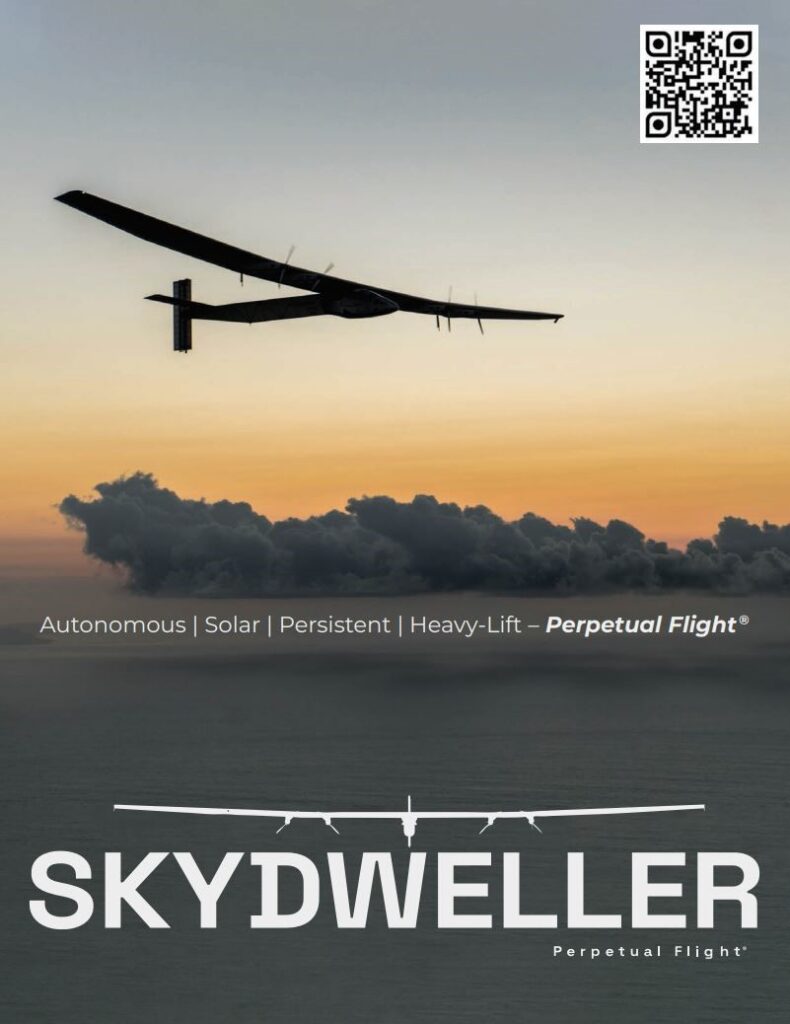

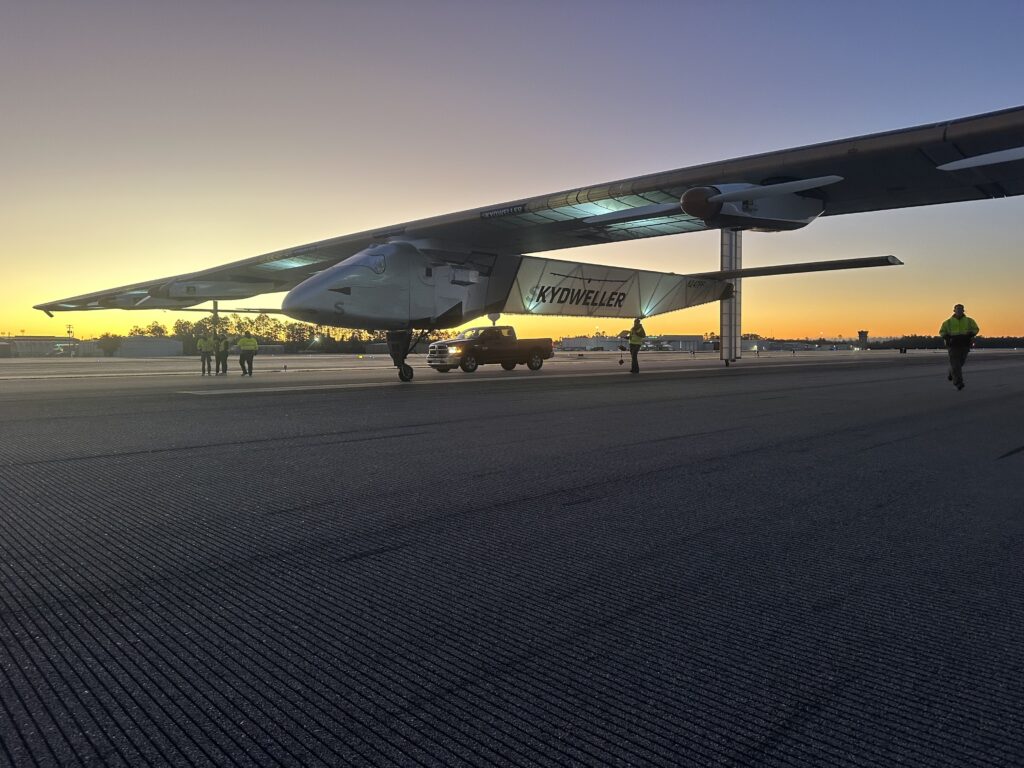
OKLAHOMA CITY | 16 December 2024 – Skydweller Aero Inc., a global leader in Perpetual Flight® uncrewed solar aircraft (USA), continues its Autonomous Maritime Patrol Aircraft (AMPA) flight tests of the Skydweller unmanned aerial system (UAS) with operational military payloads integrated onboard.
“Skydweller is equipped with a variety of sensor systems and is conducting flight tests out of Stennis International Airport in preparation for operations during 2025,” said Dr. Robert Miller, CEO and Co-founder of Skydweller Aero. “The resilience and robust design of our aircraft allow us to operate a multi-INT sensor suite of payloads throughout the winter, and we expect to conduct multi-day demonstrations in early 2025 over operationally relevant areas.”
These flights build upon Skydweller Aero’s successful autonomous flight trials conducted in late summer and fall 2024. Despite the challenging Gulf Coast weather—including two hurricanes—the company completed six flights between August 22 and September 22, four of which were fully autonomous. The longest missions lasted 16 and 22.5 hours respectively, demonstrating the aircraft’s operational effectiveness over land and offshore environments, as well as at altitudes of up to 33,000 feet.
“The aircraft maintained an impressive operational tempo, flying on average one mission every five days,” Dr. Miller added. “This performance showcases the reliability and ease of maintenance of our platform.”
Operating amid peak Atlantic hurricane season, Skydweller’s Flight Operations, Weather Scientists, and Ground Support teams worked together to fine-tune the aircraft’s autonomous capabilities, ensuring a rapid response to shifting weather conditions.
“Flying in close proximity to Mississippi thunderstorms allowed us to test and enhance our weather-avoidance systems. Skydweller’s ability to navigate these conditions highlights its operational value, especially in tropical regions during hurricane and typhoon seasons.” explained Dr. Miller. “This ability to navigate around dynamic weather patterns is vital for missions that require flight in challenging environments; avoiding sudden thunderstorms is similar to evading air defenses.”
“And unlike many other uncrewed aircraft, we are not limited to clear-sky operations in controlled environments, like the Arizona or New Mexico deserts, but will operate in operationally relevant theaters,” he added.
The Skydweller is distinguished by its durable design, exceptional payload capacity and substantial power output for mission-critical systems, offering kilowatts of continuous power for payloads. This unique combination enables Skydweller to undertake extreme duration missions across diverse and challenging environmental conditions.
“Skydweller’s capabilities have been consistently validated through rigorous flight testing, achieving significant milestones without any safety incidents,” said Barry Matsumori, President & COO of Skydweller Aero. “By leveraging our team’s deep expertise in aeroelastics, flight control systems, mission systems, and autonomy, we are developing what we believe to be the world’s first operationally viable perpetual flight platform—designed to serve the needs of both government and commercial markets.”
About Skydweller Aero Inc.
Skydweller Aero Inc. is a pioneering transatlantic aerospace company developing a fleet of the world’s largest solar powered uncrewed aircraft capable of performing extreme endurance flights with heavy, powerful payloads. Skydweller autonomous all carbon fiber aircraft have a wingspan greater than a 747 and weigh about the same as a Ford F-150. Skydweller’s uncrewed aircraft will be used for ultra-long duration missions such as providing exclusive economic zone (EEZ) enforcement, monitoring naval activity, and detecting drug smugglers and pirates at sea. Skydwellers accomplish these missions with zero carbon footprint. Skydweller Aero Inc., backed by venture and private capital, has World and US headquarters in Oklahoma City and European offices headquartered in Spain. http://www.skydweller.aero

FOX’s CyberGuy Features Skydweller Aero
Solar-powered aircraft achieves groundbreaking 22-hour autonomous flight
How perpetual flights could soon be reality
Imagine an aircraft that can stay airborne for weeks, even months, without refueling. This isn’t futuristic fantasy.
Skydweller Aero is working toward turning this vision into reality with its innovative solar-powered plane.
As the world’s largest unmanned solar-powered aircraft, Skydweller is pushing the boundaries of what’s possible in aviation.
The Skydweller advantage
What sets Skydweller apart from its predecessors? Its foundation is built on the Solar Impulse, the first solar-powered aircraft to circumnavigate the globe. This heritage provides Skydweller with a robust design capable of carrying substantial payloads. With a wingspan of 236 feet (larger than a 747) and weighing just 5,620 pounds (about the same weight as a Ford F150), the Skydweller can carry up to 800 pounds of payload.
A milestone achievement
Skydweller Aero recently achieved a significant milestone by completing a series of uncrewed autonomous flight tests. The longest of these flights lasted an impressive 22½ hours, launched from the company’s facility at Stennis International Airport in Kiln, Mississippi. This achievement demonstrates the feasibility of remaining airborne for extended periods using solar energy and batteries.
Kurt’s key takeaways
As the world’s largest unmanned solar aircraft, Skydweller Aero is revolutionizing aviation and opening up exciting new possibilities. From enhancing maritime patrols to serving as airborne communication platforms, the potential applications are vast.
Watch / read FOX’s CyberGuy Feature Skydweller Aero:
Link to video – https://www.foxnews.com/video/6364663907112
Link to article – Solar-powered aircraft achieves groundbreaking 22-hour autonomous flight | Fox News Video