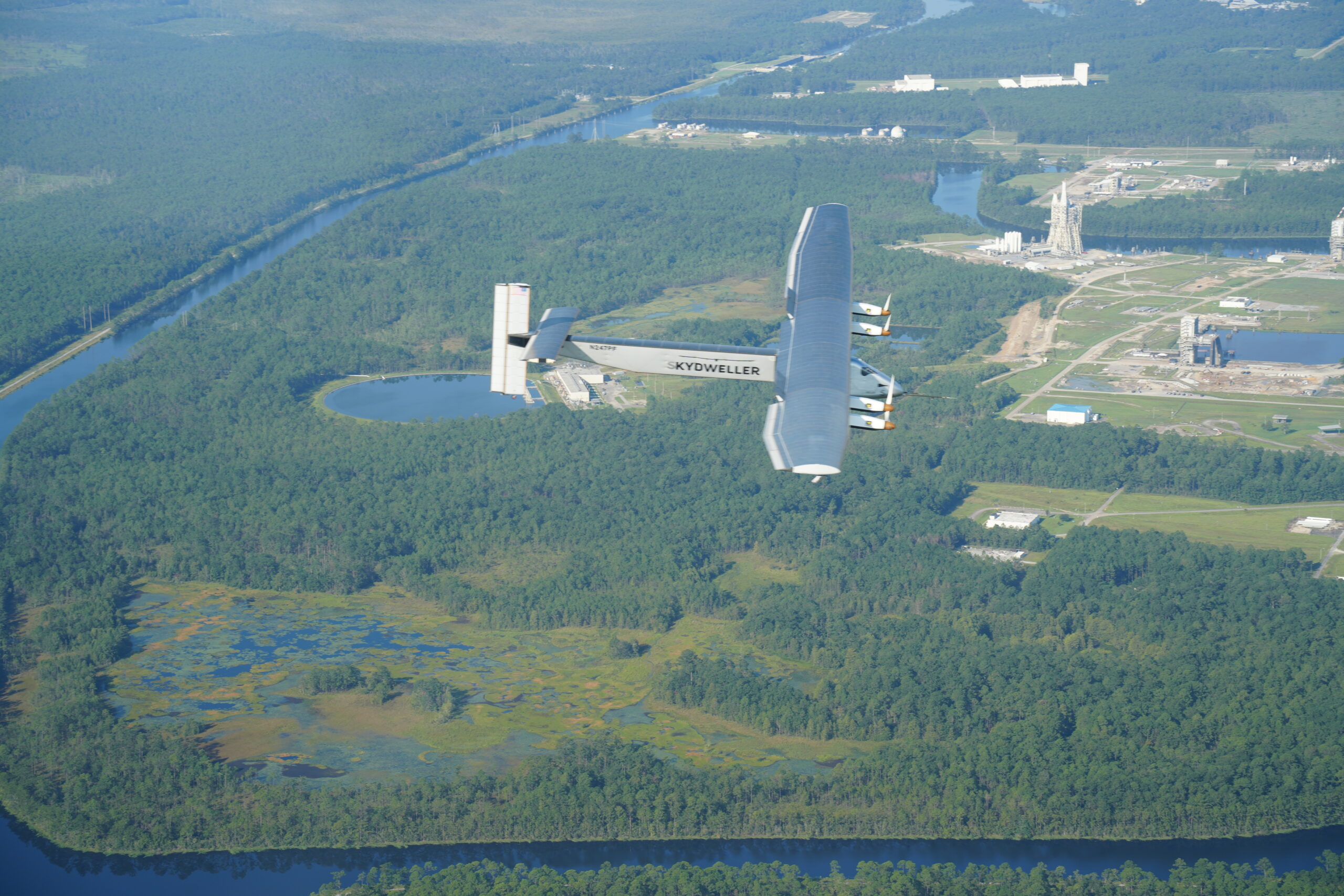
Skydweller solar-powered aircraft in flight, to be used for U.S. Air Force rapid-deployment airborne network project.
Skydweller Aero, Nokia Federal, and Tangram Flex partner with the U.S. Air Force to develop a Rapid-Deployment Airborne Network.


OKLAHOMA CITY — 14 January 2026 — Skydweller Aero, in partnership with Nokia Federal Solutions and Tangram Flex, has been awarded a U.S. Air Force contract to demonstrate a rapidly deployable airborne private network — essentially a flying 5G cell tower. The technology could provide flexible communication for military and commercial operations.

The initiative, officially titled “Instantaneous Network Infrastructure: Rapid-Deployment of Airborne Private Network on Uncrewed Perpetual Flight Platform,” leverages Skydweller Aero’s Perpetual Flight® solar-powered aircraft. The platform combines high payload capacity with extreme endurance, enabling a reconfigurable airborne communication hub.

“Skydweller’s autonomous aircraft allows us to rethink how airborne networks are deployed,” said Robert Miller, CEO of Skydweller Aero. “For our customers, this means faster, more flexible connectivity that links manned and unmanned systems seamlessly — all while reducing operational costs and complexity compared with traditional solutions.”

For the demonstration, Skydweller will host Nokia’s 5G network. Scott Ferguson, Chief Revenue Officer, Nokia Federal Solutions, said, “Nokia’s 5G technology was built for dynamic, high-performance operations. Integrating it with Skydweller’s perpetual aircraft enables an entirely new class of airborne network capability that is continuous, flexible, and ready to connect forces faster than ever.”

Tangram Flex’s interoperability software will ensure compatibility with existing and emerging military systems. Caitlin Dohrman, CEO of Tangram Flex, said, “Our software enables the rapid integration of heterogeneous communication and mission systems, so they work together seamlessly, providing flexibility and scalability for a wide range of operations.”

The combined, modular solution will implement open standards, such as OMS and UCI, to demonstrate a software-defined airborne network capable of supporting high-value manned and unmanned platforms, as well as low-cost, attritable assets — essentially making Skydweller a central airborne hub for modern networked operations, including potential integration with the Air Force’s Joint All-Domain Command and Control (JADC2) initiatives.

The Air Force Research Laboratory awarded this Direct to Phase 2 Small Business Innovation Research (SBIR) contract, with a performance period from August 2025 to August 2027. Contract value was not disclosed.

# # #

Contact:

Skydweller US
Greg Caires | greg.caires@skydweller.us | 202.870.4658

Nokia Federal
Jacqueline Lampert | media@nokiafederal.com

About Skydweller US

Skydweller Aero Inc. is a pioneering transatlantic aerospace company with a mission of developing and manufacturing a fleet of very large solar powered aircraft capable of achieving perpetual flight with heavy, powerful payloads. Their vision is to build the world’s first commercially viable perpetual flight solar powered aircraft that can carry up to 800lbs of payload, significantly more than any other solar powered aircraft, providing 2kW of power on average, and more than 100kW instantaneous power. The Skydweller Unmanned Aircraft System (UAS) has the wingspan greater than a Boeing 747 (236 ft) and weighs about the same as a F-150 pickup truck (under 5000lbs). This capability will support a variety of missions for the US DoD and its allies. Skydweller will complement existing systems by reducing the burden on those high demand assets. Skydweller Aero Inc., primarily backed by venture and private capital, has World and US headquarters in Oklahoma City and European offices headquartered in Spain. www.Skydweller.aero

About Nokia Federal

At Nokia Federal Solutions, we build scalable secure networks for mission success. As the U.S. Government’s trusted partner for 5G mission-ready solutions, we are pioneering networks that sense, think and act by leveraging our work across mobile, fixed and cloud networks. In addition, we create value with intellectual property and long-term research, led by the award-winning Nokia Bell Labs. Our solutions are designed to meet the unique needs of federal government agencies. Through technology leadership and trusted partnerships, Nokia Federal is helping the U.S. Federal Government modernize its IP and optical networks and build 5G private and tactical wireless networks. www.nokia.com/federal-solutions/

About Tangram Flex

Tangram Flex is a purpose-driven software company. We partner with the nation’s leading defense innovators and find new ways to take on some of the toughest challenges in engineering today. Our team of developers, dreamers, and doers believe there is power in the freedom to create. https://tangramflex.com/

236-foot wingspan, 3GPP non-terrestrial networks, 5G connectivity, advanced aerial platforms, advanced autonomous systems, advanced technology, aerial assessments, Aerial data collection platforms, aerospace engineering, Aerospace innovation, Aerospace technology, AI-driven solutions, airborne communication relay, airborne systems, airborne telecommunications, Autonomous, autonomous aircraft, Autonomous airplane, Autonomous aviation, autonomous drone, autonomous flight, Autonomous maritime patrol, Autonomous plane, Autonomous reconnaissance aircraft, Autonomous solar-powered, autonomous systems, Autonomous Technology, autonomous UAS, autonomous UAV, autonomous vehicle, autonomy, Autonomy Aviation, Aviation innovation, Battery powered, beyond-line-of-sight communications, bridging the digital divide, broadband network solutions, Carbon fiber, Clean Energy, Clean Technology, climate monitoring, commercial HAPS adoption, communications relay, connectivity in remote areas, continuous aerial monitoring, cost-effective ISR, data collection and analysis, Defense Technology, defense technology innovation, digital divide, disaster response, drone, Drone Technology, drone-based environmental monitoring, Drones for maritime surveillance, earth observation, environmental monitoring, Environmental monitoring drones, extended endurance, Extreme flight endurance, forestry management, geospatial intelligence, global communications, High Altitude Platform Station (HAPS), high-altitude pseudo-satellite, High-altitude solar drones, Horus, innovative aerial solutions, inspection and monitoring services, intelligence surveillance reconnaissance, interoperability standards, ISR (Intelligence, Surveillance, and Reconnaissance), Long-duration flight, Long-endurance aerial platforms, Long-endurance aircraft, long-endurance drone, Long-endurance solar aircraft, long-endurance solutions, low environmental impact, Maritime patrol, maritime surveillance drone, Military Aircraft, military applications, Military Aviation, Military surveillance, multidomain operations, multi-mission capabilities, non-terrestrial communication, operational effectiveness, payload flexibility, Perpetual flight, persistence, persistent aerial monitoring, persistent aerial surveillance, persistent surveillance, Persistent surveillance drones, Phasa 35, real-time intelligence, Reconnaissance, remote area connectivity, renewable energy platform, sky dweller, sky dweller aero, sky dweller aircraft, sky dweller airplane, sky dweller drone, sky dweller plane, sky dweller uav, Skydweller, Skydweller Aero, skydweller aero inc, skydweller aero mississippi, skydweller aero photos, skydweller aero stock, skydweller aero website, skydweller aerospace, skydweller aircraft, skydweller airplane, skydweller company, skydweller drone, skydweller haps, skydweller plane, skydweller sl, skydweller solar aircraft, skydweller technologies, skydweller technologies inc, skydweller uas, skydweller uav, skydweller.aero, skydwellers, solar aircraft, solar drone, Solar UAV for military applications, Solar-powered aircraft, solar-powered drone, solar-powered UAV, stratospheric communications, Sunglider, Surveillance, surveillance solutions, sustainable aviation, telecom and aviation collaboration, UAS, UAV, Uncrewed, uncrewed aerial system, uncrewed aerial vehicle, Unmanned aerial system (UAS), Unmanned aerial systems for telecom, unmanned aerial vehicles, wildfire detection, wildfire monitoring, Zephyr

January 2026

USAF Contracts Skydweller Aero, Nokia Federal, Tangram Flex | ASD News

Advancing aerospace vehicles with new aeroelastic tests | Aerospace America

December 2025:

Skydweller Gets U.S. Navy Contract For Electric Propulsion | Aviation Week Network

US Navy backs electric aircraft propulsion with $1.4M Skydweller deal | Interesting Engineering

The US Navy just put $1.4M behind a weird electric aircraft idea | Morning Overview

November 2025:

World’s Largest Perpetual Flight Aircraft to Become Nokia 5G Comms Hub for the Navy – autoevolution


October 2025:

Skydweller Completes 3-Day Unmanned Solar Flight | Aero-News Network

Skydweller Aero, Nokia Federal Solutions Awarded U.S. Navy Contract forBeyond 5G Resilient Tactical Networks | Autonomy Global

Oklahoma’s Skydweller Aero and U.S. Navy Complete Solar-Powered Flight | Aviation Pros

Oklahoma’s Aerospace Ambitions Soar as Skydweller Aero Leads Solar-Powered Flight Breakthrough | Cleveland American

U.S. Navy taps Skydweller for drone-based 5G communication trial | Defence Blog

Aerial power from the sun — How a drone aims to stay aloft 90 days non-stop | El Diario 24

Skydweller, Nokia Federal to Demonstrate Airborne 5G Network | Executive Biz

US Navy plans solar drone that stays airborne for 90 days to deliver 5G to troops | Interesting Engineering

U.S. Navy to Fund Solar Drones With Beyond 5G Connectivity – Militarnyi

Skydweller Aero and Nokia Federal Solutions Secure US Navy Contract to Develop Airborne Beyond 5G Tactical Network | Space Daily


September 2025:

Skydweller solar-powered drone completes three-day test flight – Aerospace Testing International

Skydweller Aero in Portugal’s Leading Newspaper – Diário de Notícias

Meet the Skydweller — 90-day photovoltaic plane with 17,000 solar panels to survive warsEl Diario 24

Solar-powered uncrewed aircraft completes 74-hour nonstop flightGlobal Air

Skydweller Pushes Solar Drone to Nonstop 3-Day Flight With 800-Pound PayloadThe Defense Post


August 2025:

Le Skydweller vole 73 heures d’affilée – Aerobuzz

American drone successfully completes three-day flight – Aeronaut Media

U.S. Navy Tests Solar Drone in 73-Hour Nonstop Flight – AirGuide.info :: AirGuide Business – AirGuide

Meet Skydweller: The autonomous solar-powered drone that can fly for 3 months without landing – AOL

Navy Demos Multi-day Solar UAS Flight – ASD News

Autonomous Skydweller Makes 3-day flight – Aviation Week

Navy’s New Drone Refuels on Sunlight, Stays Airborne for Days – AVweb

A solar-powered drone tests limits off Mississippi Gulf Coast – Biloxi Sun Herald

Larger than Boeing 747: US tests massive solar-powered drone –  Caliber.Az

Solar drone soars nonstop for 3 Days – CyberGuy

Skydweller: Groundbreaking Solar-powered UAS in 73-Hour Flight! – Defense Point.GR

Navy’s Skydweller Drone Soars For 73 Hours On Solar Power: A New Era for Maritime Surveillance – Drone XL

Drone with Boeing 747-sized wingspan flies 74 hours non-stop on only solar power – el.kz

MASSIVE solar drone flies for days on end without recharging – Electrik

US Navy conducts 73-hour solar-powered flight test with Skydweller UAS for long-endurance ISR missions – Flight Global

Solar drone soars for 3 days – GlobalSpec

73 hours in the air without a pilot: the record-breaking flight that powers the electric aviation of the future – Hibridos y Electricos

Solar-Powered UAV Completes 74-Hour Flight – iHLS

Skydweller and Navy solar flight lasts 73 hours – Inspenet

Drone with Boeing 747-sized wingspan flies for 74 hours on solar power – Interesting Engineering

747-Sized Drone Flies For Three Days On Solar Power Alone – Jalopnik

UK media: U.S. drone completes three-day unmanned flight trial – Londynek

Skydweller: Perpetual Flight Might Be Closer Than We Think – Men’s Gear

Solar-powered drone with wingspan wider than jumbo jet can fly for months – Min News

Aviation giant unveils aircraft that soars a month without refuelling – US navy already testing it – MSN

Aviation company unveils massive aircraft that can fly for month straight without landing: ‘Changes the paradigm’ – MSN

Long Time No Land: Experimental US Navy Drone Stays In Air For Three Days – Navy Leaders

This solar-powered drone just set a record for longest flight – News Bytes

Skydweller Aero tests solar-powered UAV with the US Navy – Orbital Today

The new giant drone that works with sunlight and could have military applications – La Razon

Environmentally friendly, but very dangerous: the US Navy has a new drone that works with sunlight – La Razon

Full-on spying! The Skydweller solar drone flies for nearly three days non-stop. – Red Hot Cyber

Breathtaking performance. Skydweller, the solar-powered drone, flew for 73 consecutive hours – Romania TV

Navy Demonstrates Multi-Day Solar UAS Flight – Seapower

Solar-powered drone with wingspan of Boeing 747 flies 74 hours non-stop – Supercar Blondie

The Navy flew a solar-powered drone for 73 hours straight – Task & Purpose

Solar-Powered Drone Platform Is a Game Changer for Ocean Surveillance – Thomas

Navy Demonstrates Multi-Day Solar UAS Flight – UAS Magazine

U.S. drone completes three-day unmanned flight trial – UK Defence Journal

Navy’s solar drone soared for 73 hours nonstop – USA Solar Cell

Solar drone with wingspan wider than jumbo jet could fly for months – Virtual Orbit

Skydweller: the solar-powered drone the size of a 747 that flies for three days for the US Navy. A revolution in surveillance? – Vogon Today

Aviation company unveils massive aircraft that can fly for month straight without landing: ‘Changes the paradigm’ – Yahoo Tech

L’US Navy a fait voler le drone solaire Skydweller MAPS pendant 73 heures – Zone Militaire


July 2025:

90-Day Solar Drone: Skydweller Flies Longer Than Planes! – Archyde

Converted Solar Impulse 2 aircraft demonstrates 73-Hour continuous flight for U.S. Navy ISR missions – Alert 5

US Navy Adopts Skydweller Drone for Persistent Maritime Surveillance Without Refueling – Army Recognition

Navy Demonstrates Multi-Day Solar UAS Flight – The BayNet

Meet Skydweller: The autonomous solar-powered drone that can fly for 3 months without landing – The Brighter Side of News

U.S. Navy tests long-endurance solar drone – Defence Blog

U.S. Navy and Skydweller Aero achieve breakthrough in solar-powered unmanned flight – Defence Industry Europe

Skydweller Solar Drone Completes Endurance Flight in US Navy Test – The Defence Post

U.S. Navy Flies Solar-Powered Drone for 73 Hours without Refueling – Defense Mirror

US Navy Successfully Tests Skydweller Solar Drone for Persistent, Fuel-Free Maritime Surveillance – Defensive Lines

Skydweller Aero: This solar powered drone can fly for 90 days and has self-healing code. See all amazing technical features – The Economic Times

U.S. Navy and Skydweller Aero Complete 73-Hour Solar-Powered UAS Flight for Maritime ISR – Global Defense Insight

Solar Drone With Boeing 747 Wingspan Achieves Month-Long Flight Capability – Impactful Ninja

Meet Skydweller: A solar-powered drone that can fly… – Inkl

Meet Skydweller: A solar-powered drone that can fly for 90 days straight — it’s wider and 160 times lighter than a Boeing 747 – Live Science

Navy completes 73-hour solar UAS flight with Skydweller platform – Military Embedded Systems

A Solar-Powered Drone Larger than a Jumbo Jet Can Stay Airborne for Months – Mondo News

Thales, Skydweller to offer solar-powered drone for month-long patrols – MSN

Navy demonstrates multi-day solar UAS flight  – NAVAIR

Solar drone with wingspan wider than jumbo jet could fly for months – The New Scientist

Solar drone with wingspan wider than jumbo jet could fly for months – New York Daily News Online

This solar drone can fly for 90 days—fix itself midair – NewsBytes

Solar drone with wingspan wider than jumbo jet could fly for months – Ohio Digital News

This Plane Is Bigger than a 747. It Can Fly for Months on Its Own. – Popular Mechanics

Patuxent River Leads Solar UAS Breakthrough – The Southern Maryland Chronicle

Navy Demonstrates Multi-Day Non-Stop Solar UAS Flight – Southern Maryland News

US Navy Successfully Demonstrates 73-Hour Flight of Solar-Powered Drone for Maritime Surveillance – SSB Crack News

A solar-powered drone as big as a 747 is pushing limits off the Mississippi Gulf Coast – Stars and Stripes

Solar-powered 236-foot ‘Skydweller’ aircraft flies for mind-boggling 90 DAYS without stopping – The Sun UK

US Navy Adopts Skydweller Drone for Persistent Maritime Surveillance Without Refueling – Tender News International

Meet The Solar-Powered Drone That Can Fly For 90 Days Straight – And Its Wider Than A 747 – Wonderful Engineering

Skydweller’s Solar-Powered Drone Marks Milestone For Maritime Surveillance – Worldmilitaryfans.com

This Plane Is Bigger than a 747. It Can Fly for Months on Its Own. – Yahoo! Tech

Skydweller: Largest autonomous, solar-powered drone can fly for three months without landing – Yanko Design


June 2025:

Thales, Skydweller Team on Solar-powered Surveillance Drone – Aviation International News

Thales and Skydweller Introduce Solar-Powered Drones for Extended Month-Long Surveillance Operations – DEFCROS News

Thales, Skydweller to offer solar-powered drone for month-long patrols – Defense News

Wings bigger than a Boeing 747: world’s first solar-powered drone developed that can fly around the moon – Dev.ua

Skydweller and Thales launch solar drone with intelligent radar – Inspenet

Solar drone with Boeing 747 wingspan promises month-long flights – Interesting Engineering

Paris Air Show 2025: Skydweller to feature AirMaster S radar for ultra-long-endurance maritime patrol – Jane’s

Thales and Skydweller strengthen cooperation – Militär Aktuell

“We Built This to Fly Forever”: Engineers Unveil Solar Drone With 224-Foot Wingspan Capable of Month-Long Flights – Sustainability Times

Thales, Skydweller to offer solar-powered drone for month-long patrols – Tactical Gear Tech

Solar Drone Capable Of Month-Long Flights Has Just Been Unveiled – TechnoFeats

World’s first solar-powered drone with Boeing 747-sized wingspan can fly for a month – The Times Of Innovations

Thales and Skydweller launch month-long solar-powered drone patrols – USA Solar Cell

World’s first solar-powered drone with Boeing 747-sized wingspan – Zira Daily


March 2025:

Building toward (almost) perpetual flight – Aerospace America

Skydweller Aero: Solar-Powered Perpetual Flights Initiative – Av Geekery


January 2025:

Oklahoma Firm Working Toward ‘Perpetual Flight’ – AVweb

Skydweller Aero Continues Autonomous Maritime Patrol Aircraft Flight Tests with Operational Military Payloads – Militarnyi

Skydweller Aero advances autonomous solar aircraft testing for operational deployment in 2025


December 2024:

Skydweller Aero advances autonomous maritime patrol aircraft testing with military payloads

Skydweller Aero continues AMPA flight tests with operational military payloads | CompositesWorld

Skydweller Aero Pushes Boundaries with Autonomous Maritime Patrol Aircraft Flight Tests – BBN | Breakbulk.News™

Skydweller Aero continues flight tests with operational military payloads – Air Cargo Week

Skydweller Aero Continues Autonomous Maritime Patrol Aircraft Flight Tests With Operational Military Payloads – Seapower

Skydweller Aero continues Autonomous Maritime Patrol Aircraft (AMPA) Flight Tests – Naval News

Skydweller Aero Continues AMPA Flight Tests with Operatioanl Military Payloads

Skydweller continues tests – IOT Insider

Skydweller Aero continues Autonomous Maritime Patrol Aircraft (AMPA) Flight Tests with Operational Military Payloads – Aerospace Innovations

Skydweller Aero continues Autonomous Maritime Patrol Aircraft (AMPA) Flight Tests with Operational Military Payloads  – Air & Space shows International Magazine

Skydweller Aero Continues AAMPA Flight Tests with Operational Military Payloads | Industry News | Market Forecast

Skydweller Aero advances flight tests for its Autonomous Maritime Patrol Aircraft – Defense Here


November 2025:

Solar aircraft soars with groundbreaking 22-hour autonomous flight mission. | USA Solar Cell

NASA Stennis to support unmanned aircraft testing – Machinery Market News


October 2024:

MS Stennis Space Center tests uncrewed aircraft

NASA Stennis expands range operations with new Skydweller Aero agreement

NASA Stennis Takes Key Step in Expanding its Range Operations Work – WXXV News 25

NASA Stennis Expands Range Operations Efforts | Mirage News

Skydweller Aero allowed use of NASA Stennis Space Center restricted airspace – Magnolia Tribune

NASA Stennis takes key step in expanding its range operations work | News | seacoastecho.com

U.S. Navy Eternal Drone Signals The Dawn Of Practical Solar Flight (forbes.com)

Solar-powered plane off Gulf Coast could spend months in air | Business News | nola.com

Skydweller Completes Autonomous Solar-Powered Flight Tests | RealClearDefense

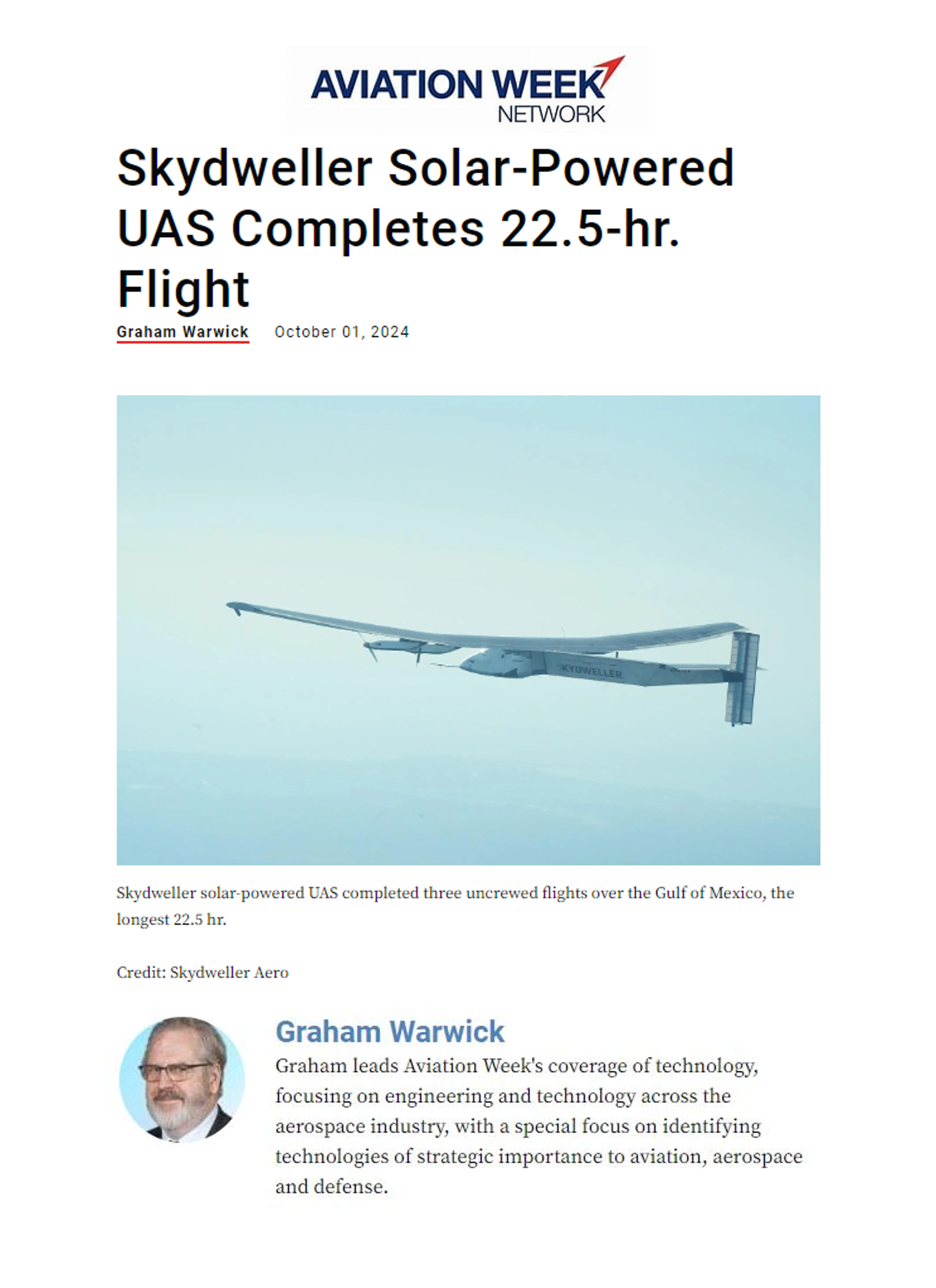
Aviation Week features Skydweller Aero – “Solar-Powered UAS Completes 22.5 hour Flight” – Skydweller

SkyDweller Aero completes tests of ultra-long-endurance solar aircraft | News | Flight Global

US-Spanish aerospace firm tests solar-powered drone with 22.5 hours of non-stop flight | IRIA News (ir-ia.com)

Skydweller Aero Completes Successful Uncrewed Solar Flight Tests (botsanddrones.uk)

Skydweller Aero Successfully Completes “First Uncrewed Flight Test Campaign” – eVTOL Insights

Skydweller Aero Successfully Completes Initial Uncrewed Flight Test Campaign – Oklahoma Department of Commerce (okcommerce.gov)

The Skydweller solar-powered drone flies continuously for 22.5 hours, making it suitable for prolonged reconnaissance (scenarieconomici.it)

Skydweller Aero: The 90-Day Solar Flight Revolution (aircomment.info)

World Military News: Skydweller Completes Autonomous Solar Powered Flight Tests

First flight: Solar-powered Skydweller — General Aviation News

Game-Changer: Solar-Powered Skydweller Drone Flies for 22.5 Hours in Breakthrough Test – MSN

Skydweller Aero Successfully Completes Uncrewed Flight Test Campaign – MilitaryLeak.COM (ampproject.org)

Skydweller successfully concludes series of autonomous flights – IOT Insider

Skydweller Aero completes initial uncrewed flight test campaign – SatNews

Skydweller Aero successfully completes initial uncrewed flight test campaign – Air Cargo Week

Skydweller Aero completes autonomous flight test campaign | CompositesWorld

Skydweller Aero Completes Uncrewed Flight Testing | Aero-News Network

Skydweller completes initial flight test campaign | Revolution.aero

Skydweller Aero Successfully Completes Uncrewed Flight Test Campaign | UAS Magazine

Solar-Powered ‘Skydweller’ Drone Flies 22.5 Hours in Test (thedefensepost.com)

Skydweller’s solar UAS aces test flight campaign, hitting milestones. | USA Solar Cell

Skydweller Aero Successfully Completes Initial Uncrewed Flight Test Campaign – Air & Space shows International Magazine (airshowsinternationalmagazine.com)

Skydweller Aero Successfully Completes Initial Uncrewed Flight Test Campaign – Aerospace Innovations (aerospace-innovations.com)

Skydweller Autonomous Solar Flight Test Completed (defencetrend.com)

News :: Airplanes :: Skydweller completes initial flight test campaign (avfoil.com)

Solar-powered Skydweller drone successfully completes flight tests for US military (armyrecognition.com)

Skydweller Aero Triumphs with Record-Setting Uncrewed Aerial Tests – UASweekly.com

Skydweller’s solar-powered UAS completes test flight campaign (aerospaceglobalnews.com)

US tests Skydweller drone with solar panels (gagadget.com)

Skydweller drone completes first uncrewed flight test campaign | Aerospace Testing International

Skydweller completes autonomous solar-powered flight tests (defence-blog.com)

Skydweller Aero Successfully Completes Uncrewed Flight Test Campaign | UAS Magazine

Skydweller Aero completes initial flight test campaign with its long-endurance UAV – European Security & Defence (euro-sd.com)

Skydweller Aero Successfully Completes Initial Uncrewed Flig (asdnews.com)

Solar-power drone completes flight test for U.S. military – Military Embedded Systems

U.S. has tested an eternal drone: What you need to know | News.az

A solar-powered plane flies continuously for more than 20 hours: this is Skydweller
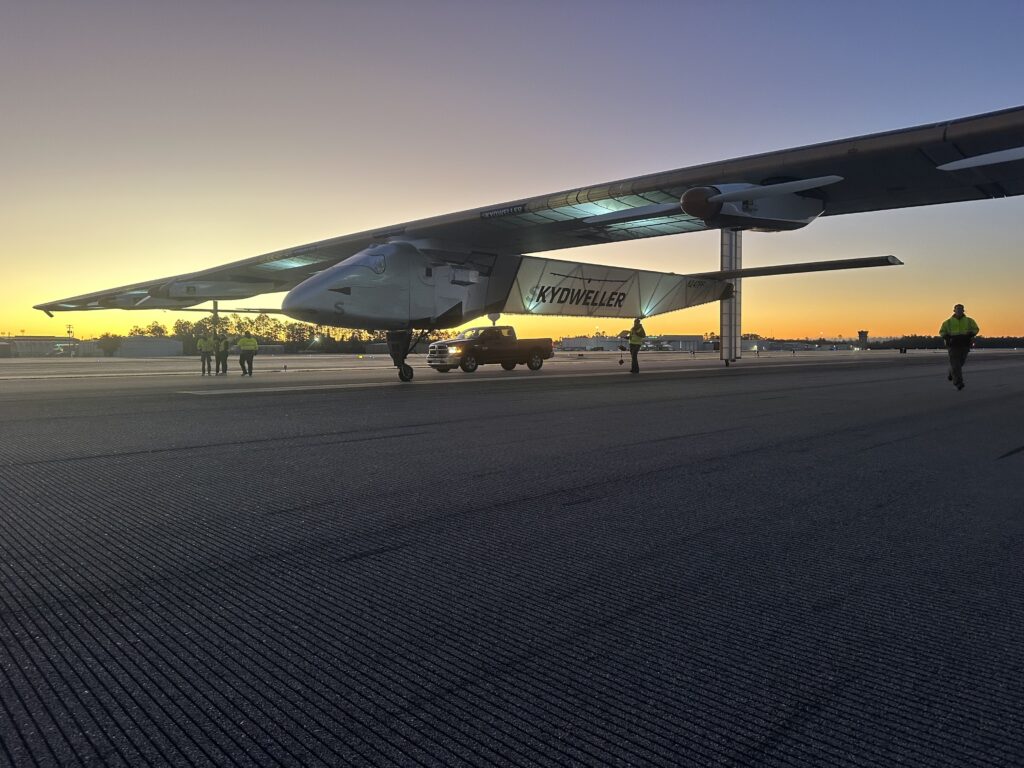
Skydweller Aero solar drone takeoff video with CEO Robert Miller on Fox News Live
CEO Robert Miller discusses the Skydweller Aero solar drone while a takeoff video plays on Fox News Live

Fox News Live Features Skydweller Aero Solar Drone

The Skydweller Aero solar drone is changing the future of aviation with its ability to stay aloft for days at a time. In a recent Fox News Live segment, CEO Robert Miller explained how this solar-powered technology enables long-duration, autonomous flight while reducing environmental impact.

By leveraging advanced aeroelasticity and lightweight structures, the Skydweller Aero solar drone achieves unmatched efficiency at high altitudes. This allows multi-day operations for maritime surveillance, environmental monitoring, and persistent communications in remote or hard-to-reach areas. Governments and commercial operators benefit from a sustainable, reliable solution that conventional aircraft cannot provide.

During the interview, Miller highlighted record-setting flights of 48, 73, and 74 hours nonstop, demonstrating the Skydweller Aero solar drone’s endurance and operational reliability. He also emphasized how these drones create new possibilities for autonomous long-range operations, research, and logistics without the need for refueling or frequent maintenance.

For more details on the company’s innovations, visit our Technology page or learn about our Multi-Day Flight Campaigns, which demonstrate the drone’s capabilities and operational milestones.

📺 Watch the full Fox News Live interview here: Skydweller CEO details the company’s solar-powered drone technology | Fox News Video

Oklahoma Department of Aerospace and Aeronautics (ODAA) Logo
Oklahoma Department of Aerospace and Aeronautics (ODAA)

We’re honored that the State of Oklahoma has recognized Skydweller Aero’s 74-hour solar-powered flight with the U.S. Navy. 🌞✈️

Thank you to the Oklahoma Department of Aerospace and Aeronautics (ODAA) for highlighting this milestone and for supporting #aerospace #innovation in our state.

This achievement demonstrates the potential for long-duration, #autonomous solar-electric flight to support maritime security, defense, and humanitarian missions. It’s an important step toward realizing month-long, solar-powered operations that can strengthen national security and expand the capabilities of unmanned aircraft.

We are proud to continue pushing the boundaries of aerospace technology and grateful for Oklahoma’s support of innovation in our industry.

Oklahoma’s Skydweller Aero Achieves Historic Solar-Powered Flight with U.S. Navy

Oklahoma’s Skydweller Aero Achieves Historic Solar-Powered Flight with U.S. Navy
Monday, September 29, 2025

OKLAHOMA CITY – The Oklahoma Department of Aerospace and Aeronautics (ODAA) congratulates Skydweller Aero, an Oklahoma-based aerospace company, on completing a groundbreaking three-day solar-powered unmanned flight in partnership with the U.S. Navy.

The 74-hour flight, conducted over the Gulf of America, marks a major advancement in unmanned aircraft technology. The solar-electric plane’s flight demonstrates the potential of long-duration, solar-powered operations to support extended ocean patrols, track vessel movements, and gather critical information without fuel.

This achievement builds on Oklahoma’s proud aviation heritage — from pioneers like Wiley Post, the first pilot to fly solo around the world — to today’s innovators pushing the boundaries of aerospace technology. The flight was made possible after years of engineering and testing led by Skydweller’s global headquarters in Oklahoma City.

“This accomplishment by Skydweller Aero shows how Oklahoma’s aerospace sector is delivering innovative solutions with global impact,” said Grayson Ardies, executive director of ODAA. “We’re excited to support companies like Skydweller that are advancing unmanned flight and strengthening America’s leadership in aerospace technology.”

During the mission, the Skydweller aircraft stayed airborne using only solar energy, operated autonomously under human supervision, and securely transmitted imagery and data from above the open ocean. Designed to remain aloft for up to 90 days, it opens new opportunities for defense and humanitarian missions — from stopping illegal fishing to enhancing search-and-rescue operations.

RuthAnne Darling, director of the Department of Defense’s Operational Energy Innovation Office, said, “This is the first time Skydweller’s solar-electric aircraft has flown continuously through a full diurnal cycle of sunshine and darkness, showing their energy budget closes under real-world conditions. This was an important step to show that month-long operational flights in places like INDOPACOM are possible in reality — not just in modeling. Our office sponsors purposeful demonstrations like this to accelerate and transition innovative capabilities that project power with increased time on station and larger payloads, fostering sustained operational reach. We are excited by Skydweller’s success.”

“I am proud of Skydweller’s historic solar-powered flight, a groundbreaking milestone in aerospace innovation,” said Congresswoman Stephanie Bice (OK-5). “Their partnership with the U.S. Navy shows how Oklahoma continues to lead the way in developing technology that supports our military and strengthens national defense.”

Since 2020, Skydweller Aero has partnered with the U.S. military to address pressing security challenges including drug trafficking, illegal fishing, maritime security, and border awareness. More flights are planned in the U.S. Southern Command’s operating region and along the U.S. southern border. From its base in Oklahoma, Skydweller Aero continues to advance groundbreaking technology.

Close-up of a WLOX-TV video camera filming Skydweller Aero’s solar-powered multiday flights in Mississippi
Biloxi’s WLOX-TV captures footage of Skydweller Aero’s autonomous, solar-powered multiday flights from Mississippi’s Gulf Coast.

Skydweller Aero’s multiday solar-powered flights from Mississippi were recently featured by Biloxi’s WLOX-TV. This local TV segment highlights how our autonomous aircraft is safely conducting repeatable, extreme-endurance missions from Stennis International Airport. As a result, viewers can see firsthand the capabilities of solar-powered, long-endurance flight technology.

Proving Multiday Solar Flights from Mississippi’s Gulf Coast

Mississippi provides the ideal environment to advance this technology. With controlled airspace, access to Gulf operating areas, and the support of NASA’s Stennis Space Center, Hancock County, and the State of Mississippi, Skydweller Aero is scaling its platform and building its future in the region. Additionally, Stennis will serve as the home of our U.S. aircraft assembly operations, strengthening Mississippi’s role in aerospace innovation.

Partnering with the U.S. Navy for Real-World Missions

Operating from Mississippi’s Gulf Coast, Skydweller Aero has shown that sustained, solar-powered endurance is no longer just a concept. In partnership with the U.S. Navy, our aircraft has flown nonstop for more than 48, 73, and even 74 hours. These missions carried meaningful payloads and demonstrated how solar-powered multiday flights can deliver cost-effective, persistent surveillance and communications.

Mission Impact: Surveillance, Security, and Environmental Monitoring

This WLOX-TV feature emphasizes both endurance and mission value. Skydweller Aero’s autonomous solar-powered aircraft supports coastal surveillance, maritime security, environmental monitoring, and resilient communications. For example, it can help spot illegal fishing and smuggling, track oil spills, or provide rapid communications following disasters. Ultimately, the aircraft delivers critical capabilities for both defense and civilian applications.

👉 Link to WLOX’s segment here.

Learn more about Skydweller Aero’s solar-powered aircraft and how it is redefining extreme-endurance flight for real-world missions here.

We proud to bring extreme-endurance, solar-powered flight to life from Mississippi, building the future of solar-powered autonomous aviation and delivering solutions that make a difference.

Skydweller Aero featured in Portugal’s newspaper of record, Diário de Notícias, for its solar-powered autonomous aircraft and maritime surveillance capabilities
Portugal’s Diário de Notícias highlights Skydweller Aero’s solar-powered aircraft and its role in advancing maritime domain awareness and security. (Sept. 19, 2025)

Skydweller Aero Featured in Portugal’s Leading Newspaper: Diário de Notícias

On September 19, 2025, Diário de Notícias — Portugal’s newspaper of record — published a feature on Skydweller Aero, highlighting its solar-powered autonomous aircraft and European operations. This recognition highlights the company’s growing role in Europe and its ability to deliver long-endurance solutions for maritime domain awareness, border protection, and security missions.

Pioneering Perpetual Flight®
The Skydweller aircraft is the first solar-powered, fully autonomous platform capable of flying for weeks to months at a time while carrying payloads of up to 400 kilograms. This makes Skydweller Aero central to missions such as illegal fishing prevention, environmental monitoring, disaster response, and 5G communications support.

As noted in the feature, “The Azores, for example, could serve as an excellent base of operations for the type of maritime surveillance missions our aircraft was designed for. This would be an excellent tool to assert Portugal’s rights.”

Strengthening European Partnerships
Skydweller Aero is preparing to establish a long-term operations base in the Canary Islands in partnership with the Spanish government. This hub will provide a foundation for persistent surveillance against smuggling and trafficking — missions already demonstrated in collaboration with the U.S. Navy.

Looking ahead, Skydweller Aero is expected to expand cooperation with European agencies such as Frontex, providing EU member states with access to affordable, persistent surveillance.

This recognition in Diário de Notícias underscores Skydweller Aero’s mission to pioneer Perpetual Flight® and redefine the future of autonomous aviation for Europe and beyond.

📖 Read the original article in Diário de Notícias; English and Portuguese text below.

🌍 Learn more about our missions and technology.

Interview with Skydweller Aero’s CEO in Portugal’s leading newspaper 

DIÁRIO DE NOTICIAS  

19 September 2025

“This would be an excellent tool to assert Portugal’s rights”

ROBERT MILLER, CEO of Skydweller Aero, talks to DV/DN about the future of aviation, the challenges of creating a solar-powered drone capable of flying for months, and how its technology could be a game-changer for Portugal’s security and sovereignty. Next spring, he will establish a base of operations in the Canary Islands, in collaboration with the Spanish government, but he envisions how the Azores, for example, could be an excellent location for the type of maritime surveillance missions for which the aircraft was designed.

Skydweller Aero is a transatlantic aerospace company aiming to revolutionize long-endurance aerial missions. At the heart of its innovation is the Skydweller aircraft, a fully autonomous drone with the wingspan of a Boeing 747, covered in solar panels, capable of a variety of applications.

Leading this project is Robert Miller, the co-founder and CEO of Skydweller Aero. An expert in unmanned aerial vehicles, he has a long career in the aerospace and defense sectors, having held senior positions at companies such as Northrop Grumman. He holds a doctorate in Aerospace Engineering and several degrees from Stanford University.

What is Skydweller Aero’s primary mission?

We are bringing perpetual flight to the world. What I mean by perpetual flight is the ability of an aircraft to fly for weeks to months. And the usefulness of an aircraft is actually defined by the amount of cargo it can carry. We are the first solar-powered aircraft that can actually fly for those weeks to months and carry a significant payload, up to 400 kilograms of payload.

You mention a ‘significant payload.’ What kind of capabilities does this enable? Different types of missions.

You can do 5G communications, you can do geospatial data collection, you can do military surveillance, you can do electronic warfare, you can do communications… There are many things you can do.

What were the biggest technological challenges in converting the Solar Impulse 2, a manned aircraft that pioneered the first solar flight around the world, into a fully autonomous drone capable of perpetual flight?

When you want to fly something for weeks or months, there are many different reliability considerations involved. Therefore, probably the most important thing when converting it is to take all the functions of a pilot and make them autonomous and highly reliable.  Flying an aircraft alone isn’t, in itself, difficult; what’s difficult is flying it for weeks or months when things go wrong. And that’s what we’re doing right now.

Your current flight record is just over three days. What are the main limitations preventing you from achieving weeks or months of flight time at this point?

This is also due to the fact that we’re limited to where we can fly in a flight test area. So we hope to expand beyond that in the near future. It’s another limitation of having to stay in a small area. [The test area is in the Caribbean] When we’re flying in July in the Gulf of America, the weather isn’t very good. If bad weather hits, we have to leave the area, which we could easily do. If we were 8 or 16 kilometers north, we would have been fine, but we couldn’t leave the area because that’s where we’re limited to flying.

This reliance on solar energy highlights the importance of underlying technologies, such as batteries, which store energy for night flight. As an engineer, do you feel that the pace of innovation in areas like batteries and solar cells is lagging?

I wouldn’t say I’m disappointed. I wish the performance were better. But we have enough… as the song says, you can’t get what you want, but you get what you need. We get enough to get what we need. Yes, the pace of innovation… there’s a lot more investment being made in batteries. And there’s still a lot of investment in solar cells. And things are getting better and lighter. Electric motors have improved a lot recently. There are a lot of things that are improving performance here.

They are establishing a long-term operations base in the Canary Islands. What is the strategic objective of this measure, and what kind of agreement do you have with the Spanish government?

We plan to conduct long-term operations in the Canary Islands. It’s a good location for us to conduct some operations, and the need exists. It fits our profile well, so we’re excited. The Canary Islands offer an opportunity to conduct the same type of missions we would in the Caribbean. There’s a lot of illegal activity in the Caribbean—illegal drugs, human trafficking. The same problems exist in the Canary Islands; it’s a very similar mission. We have an agreement to work there with the Spanish government.

Portugal faces similar challenges, with a vast maritime domain and problems like illegal fishing and forest fires. Have you had any official contact with the Portuguese government, and do you see a role for Skydweller in monitoring strategic areas like the Azores, for example?

We had one or two initial conversations several years ago, but we plan to talk more with them in the near future. I completely agree that the Azores and the Atlantic area west of the Azores need aerial surveillance. Portugal’s Exclusive Economic Zone, illegal fishing, things like that… this would be an excellent tool for enforcing Portugal’s rights. While we have no current plans to do so, we hope that in the future, after establishing ourselves and operating in the Canaries, we will operate for Portugal and do some of the things you mentioned—they are next on the list, hopefully.

I know you’re going to start working with the EU’s Frontex agency.  Will Portugal benefit from the security data they collect?

Oh, yes. We hope to work with Frontex. I have to be careful about what I say for now. But yes, when we work with Frontex. In the future, Portugal will benefit from this.

Regarding cost, in a recent interview you published a power-by-the-hour service model.  For a country that wants 24/7 surveillance, what order of magnitude would we talk about for an annual service contract? And do governments typically purchase an aircraft or lease the service?

It depends on the mission. I’d rather not go into exact details right now, because it really depends on the mission and a lot on the structure around what we’re trying to accomplish. We can have several people involved, the cost of a minute. The operating cost of this aircraft is very low… on the order of a CS-23 aircraft, that is, a light aircraft. We do both. We sell aircraft to governments and train their personnel to operate them; or we operate them for them after selling them. We also offer leasing options.

You’ve flown missions for the US Navy. What can you tell us about the nature of this work?

I can’t go into too much detail, but it’s basically about tracking down illegal activity. We did a campaign in July where we flew 222 hours and 45 minutes in 20 days—several multi-day missions. This was largely determined by the weather at that time of year in the Gulf of America.

Many surveillance drones eventually evolve to have weaponized capabilities. Is the Skydweller platform designed to carry lethal payloads? What is your company’s official position on weaponizing the aircraft?

Well, it’s an aircraft. You can buy a Pilatus or an Airbus and you can drop things from aircraft. Any aircraft can do that. We currently have no plans to weaponize the aircraft, nor have any of our customers asked us to do so, so far. But if you sell an aircraft to a government, it’s their aircraft to do whatever they want with.  It’s designed to be an aircraft that flies for weeks to months. It’s not particularly designed to be a weapon in that regard.

Do you foresee a future, similar to what we see in science fiction films like Interstellar, in which autonomous aircraft constantly monitor not just borders, but entire landscapes for everything from security to environmental management?

I see a dramatic increase in the next 10 to 20 years of autonomous aircraft monitoring borders, exclusive economic zones, forest fires, things like that. In communications, I think there will be a gap-filling there. Yes, we will have some satellite communication, but there are gaps that will be opportunities for drones to fill as well.

Based on your experience, how far is the aviation industry in general from a paradigm shift to electric, away from fuel?

It shouldn’t really apply to passengers. [Solar power] will be able to carry light cargo. And it will be efficient in doing communications, surveillance, data collection, things like that. That’s where I think you’ll see a big market for solar-powered aircraft.

Do you believe autonomous flight is the future for all aviation, leading to pilotless cargo and passenger planes?

Yes, I believe it’s coming. There’s really no reason for there to be too many pilots. I was at a conference in Austin, Texas, and I called an Uber and a driverless car showed up. I got in and drove around the city, no problem. If you can do that, you can do it in a plane.


Artigo sobre o Skydweller Aero

DIARIO DE NOTICIAS (Portugal) 

19 de setembro de 2025

Tecnologia

“Esta seria uma excelente ferramenta para fazer valer os direitos de Portugal”

ROBERT MILLER CEO da Skydweller Aero fala com o DV/DN sobre o futuro da aviação, os desafios de criar um drone movido a energia solar capaz de voar durante meses e como a sua tecnologia pode ser um fator de mudança para a segurança e soberania de Portugal. Já na próxima primaverá irá estabelcer uma base de operações nas Canárias, em colaboração com o governo espanhol, mas antevê como os Açores, por exemplo, poderiam ser local de excelência para o tipo de missões de vigilância maritima para que a aeronave foi concebida

A Skydweller Aero é uma empresa aeroespacial transatlântica que visa revolucionar as missões aéreas de longa duração. No centro da sua inovação está a aeronave Skydweller um droneto-talmente autónomo, com a envergadura de um Boeing 747, coberto de painéis solares, é capaz. de uma variedade de aplicações.A liderar este projeto está Robert Miller, o cofundador e CEO da Skydweller Aero. Especialista na área dos veiculos aéreos não-tri-pulados, tem uma longa carreira nos setores aeroespacial e de de-fesa, tendo ocupado cargos de chetia em empresas como a Northrop Grumman. Possui um doutoramento em Engenharia Aeroespacial e vários diplomas da Universidade de Stanford.

Qual é a missão principal da Skydweller Aero?

Estamos a trazer o voo perpétuo ao mundo. O que quero dizer com voo perpétuo é a capacidade de uma aeronave voar durante semanas a meses. E a utilidade de uma aeronave é, na verdade. definida pela quantidade de carga que consegue transportar. Somos a primeira aeronave movida a energia solar que pode realmente voar durante essas semanas a meses e transportar uma carga útil significativa, até 400 quilogramas de carga útil.

Menciona uma ‘carga útil signi-ficativa. Que tipo de capacidades é que isso permite? Diferentes tipos de missões.

Pode fazer comunicações 5G, pode fazer recolha de dados geoespaciais, pode fazer vigilância para militares, pode fazer guerra eletrónica, pode fazer co-municações.. Há muitas coisas que se podem fazer.

Quais foram os maiores desafios tecnológicos ao fazer a conversão da Solar Impulse 2, uma aeronave tripulada que foi pioneira a fazer o primeiro voo solar à volta do mundo, num drone totalmente autónomo capaz de voo perpétuo?

Quando se quer fazer algo voar durante semanas a meses, há muita fiabilidade diferente en-volvida. Portanto, provavelmente o mais importante é, ao con-vertê-lo, pegar em todas as funções de um piloto e torná-las autónomas e altamente fiáveis.  Fazer uma aeronave voar sozinha não é, por si só, dificil; o difi-cil é fazê-la voar durante semanas a meses, quando as coisas correm mal. E isso que estamos a fazer neste momento.

O vosso recorde de voo atualé de pouco mais de três dias. Quais são as principais limitações que vos impedem de atingir semanas ou meses de tempo de voo neste momento?

Isso também se deve ao facto de estarmos limitados ao local onde podemos voar numa área de teste de voo. Por isso, esperamos ir além disso num futuro próximo.  É mais uma limitação de termos de permanecer numa área pe-quena. [A zona de testes é nas Caraíbas] Quando estamos a voar em julho, no Golfo da Amé-rica, o tempo não é muito bom.  Se o mau tempo aparecer, temos de sair da área, o que poderíamos fazer facilmente. Se fösse-mos 8 ou 16 quilómetros para norte, teríamos ficado bem, mas não podiamos sair da área porque é aí que estamos limitados a voar.

Esta dependência da energia solar aponta para a importância das tecnologias subjacentes, como as baterias, que armaze-nama energia para o voo notur-no. Como engenheiro, sente que o ritmo da inovação em áreas como baterias e células solares está a ficar para trás?

Eu não diria que estou desapon-tado. Gostaria que o desempenho fosse melhor. Mas temos o suficiente… como diz a canção, não se consegue o que se quer, mas consegue-se o que se preci-sa. Nos conseguimos o suficiente para obter o que precisamos.  Sim, o ritmo da inovação… está a ser investido muito mais em ba-terias. E ainda se investe muito em células solares. E as coisas estão a ficar melhores e mais leves. Os motores elétricos melhoraram muito recentemente. Há muitas coisas que estão a melho-raro desempenho aqui.

Estão a estabelecer uma base de operações de longo prazo nasilhas Canárias. Qual é o objetivo estratégico desta medida e que tipo de acordo têm com o governo espanhol?

Planeamos realizar operações de longo prazo nas Canárias. Eum bom local para realizarmos algumas operações, e a necessidade existe. Encaixa-se bem no nosso perfil, por isso estamos entusias-mados. As Canárias oferecem uma oportunidade para realizar o mesmo tipo de missões que faríamos nas Caraíbas. Há muita atividade ilegal nas Caraibas – drogas ilegais, tráfico de seres humanos. Os mesmos problemas existem nas Canárias, é uma missão muito semelhante. Temos um acordo para lá trabalhar com o governo espanhol.

Portugal enfrenta desafios semelhantes, com um vasto domi-nio maritimo e problemas como a pesca ilegal e os incêndios flo-restais. Tiveram algum contac-to oficial com o Governo português e veemumpapel paraa Skydweller na monitorização de áreas estratégicas como os Açores, por exemplo?

Tivemos uma ou duas conversas iniciais há vários anos, mas planeamos falar mais com eles num futuro próximo. Concordo totalmente que os Açores e a área do Atlântico a oeste dos Açores necessitam de vigilância aérea. A Zona Económica Exclusiva de Portugal, a pesca ilegal, coisas desse género… esta seria uma excelente ferramenta para fazer valer os direitos de Portugal. Embora não tenhamos planos atuais para o fazer, esperamos que, no futuro, depois de nos estabelecermos e operarmos nas Canárias, venhamos a operar para Portugal e fazer algumas das coisas que mencionou – são o ponto seguinte da lista, esperemos.

Sei que vão começar a trabalhar comaagência Frontex da UE. Portugal beneficiará dos dados de segurança que recolherem?

Oh, sim. Esperamos trabalhar com a Frontex. Tenho de ter cuidado com o que posso dizer por agora…   Mas sim, quando trabalharmos com a Frontex no futuro, Portugal beneficiará disso.

Em relação ao custo, numa entrevista recente mencionou um modelo de serviço power by the hour’ (energia por hora).

Para um país que queira vigilância 24/7, de que ordem de grandeza estamos a falar para um contrato de serviço anual? E os governos normalmente compram a aeronave ou alugam o serviço?

Depende da missão. Prefiro não entrar em detalhes exatos agora, porque depende realmente da missão e de muita da estrutura em torno do que estamos a tentar fazer. Se pudermos ter várias pessoas envolvidas, o custo di-minui. O custo operacional desta aeronave é muito baixo… na ordem do de uma aeronave CS-

-23, ou seja, uma aeronave ligei-ra. Fazemos as duas coisas. Vendemos a aeronave a governos e treinamos o seu pessoal para a operar; ou operamo-la para eles depois de a vendermos. Também oferecemos a opção de leasing.

Járealizaram missões para a Marinha dos EUA. O que nos pode dizer sobre a natureza desse trabalho?

Não posso entrar em muitos de-talhes, mas basicamente é a procura por atividades ilegais. Fizemos uma campanha em julho, em que voámos 222 horas e 45 minutos em 20 dias – foram várias missões de vários dias. Isso foi mais determinado pelo tempo naquela época do ano no Golfo da América.

Muitos drones de vigilância acabam por evoluir para ter capacidades armadas. A plataforma Skydweller foi projetada para suportar cargas letais? Qual é a posição oficial da vossa empresa sobre armar a aerona-ve?

Bem, é uma aeronave. Pode comprar um [avião] Pilatus ou um Airbus e pode largar coisas de aeronaves. Qualquer aeronave pode fazer isso. Atualmente, não temos planos para armar a aeronave, nem nenhum dos nossos clientes nos pediu para o fazer, até ao momento. Mas se vender uma aeronave a um go-verno, é a aeronave deles para fazerem o que quiserem com ela.

Ela for projetada para ser uma aeronave que voa durante semanas a meses. Não foi particularmente projetada para ser uma arma nesse aspeto.

Prevê um futuro, semelhante ao que vemos em filmes de ficção científica como Interstellar, no qual aeronaves autónomas mnitorizam constantemente nลือ só fronteiras, mas paisagens inteiras para tudo, desde segurança à gestão ambiental?

Vejo um aumento dramático nos próximos 10 a 20 anos de aeronaves autónomas a monitorizar fronteiras, zonas económicas ex-clusivas, incêndios florestais, coisas deste género. Nas comunica-ções, acho que haverá aí um preenchimento de lacunas. Sim, vamos ter alguma comunicação por satélite, mas há lacunas que serão oportunidades para os drones preencherem também.

Com base na sua experiência, a que distância está a indústria da aviação em geral de uma mudança de paradigma para o elé-trico, para longe do combustí-vel?

Não se deverá realmente aplicar a passageiros. [A energia solar] poderá transportar carga ligeira. E eficiente a fazer missões de co-municações, vigilância, recolha de dados, coisas desse género. É aí que eu acho que se verá um grande mercado para aeronaves movidas a energia solar.

Acredita que o voo autónomo é o futuro para toda a aviação, levando a aviões de carga e de passageiros sem piloto?

Sim, acredito que isso está para vir. Não há realmente nenhuma razão para haver muitos pilotos. Estive numa conferência em Austin, Texas, chamei um Uber e apareceu um carro sem motoris-ta. Entrei e andei pela cidade, sem problemas. Se se pode fazer isso, pode fazer-se num avião.


Skydweller Aero continues to capture attention across the aerospace, defense, and technology sectors.

In recent weeks, our leadership and innovations in perpetual flight, maritime domain awareness, and solar-powered unmanned aircraft have been featured in leading podcasts worldwide.

Here are some of the latest episodes featuring Skydweller Aero:

🆕 Drone Technology Daily: UAV News & Reviews – Solar UAV Soars – 27 October 2025

Skydweller CEO details the company’s solar-powered drone technology | Fox News Video – 5 October 2025

Skydweller aero test landing at Stennis International Airport – WXXV-TV Biloxi, 24 September 2025

Skydweller Aero testing solar-powered, unmanned flights in South Mississippi – WLOX-TV Biloxi, 24 September 2025

Supertalk Mississippi – 12 September 2025

Aaron’s Weekend Recap – 12 September 2025

UAV News Talk – 9 September 2025

Tech Talk with Mathew Dickerson – 10 August 2025

Drone Technology Daily‘s Drones Unleashed – 9 August 2025

Hacker News: The Automated Daily – 1 August 2025

U.S. Navy’s All Hands: Morning Quarters – 30 July 2025

India Tech Report: Daily Morning Brief – 29 July 2025

Smart Mobility Today – 21 June 2025

Casual Space – 20 March 2025

Defense Industrial Base Innovators – 18 March 2025

From discussions on the future of perpetual flight to breakthroughs in solar-powered UAS technology, these conversations highlight Skydweller’s role in shaping the future of aerospace and national security.

👉 Stay tuned as we continue to share insights, innovations, and milestones through media around the world.

Skydweller long duration flights video – solar-powered uncrewed aircraft in flight

Skydweller’s long duration flights made history during July 2025, demonstrating the autonomous solar-powered aircraft’s capability for staying aloft for days at a time.

Our new video highlights these history-making missions and showcases how uncrewed aircraft can provide persistent airborne solutions for governments, industry, and global partners.

Highlights from Skydweller’s Long Duration Flights:

In just 20 days, our aircraft completed:

  • 48-hour flight

  • 73-hour flight

  • 74-hour flight

  • Totaling 222+ flight hours — more than 9 days aloft

These achievements demonstrated the endurance, resilience, and robustness of Skydweller’s Perpetual Flight® technology.

Mission Impact:

The Skydweller long duration flights video captures more than flight data — it illustrates the transformative potential of extended, zero-emission flight for:

  • Maritime domain awareness, detecting illicit trafficking, piracy, and illegal fishing

  • Environmental monitoring, from wildfire detection to climate observation

  • National security missions, extending communications and ISR beyond legacy systems

Watch the Video:

Now you can see the story behind the numbers.

Our video showcases the campaign that proved Skydweller’s long duration flights can deliver sustained, zero-emission flight that transforms missions across defense, security, communications, and environmental monitoring.

👉 Watch the full video here: https://youtu.be/QC32N528ub4

Future Skydweller Long Duration Flights

At Skydweller Aero, we are building the world’s first solar-powered aircraft capable of extreme endurance while carrying significant payload weights.

This video showcases not just flight hours, but the future of Skydweller long duration flights as persistent airborne solutions.

Learn more about our Perpetual Flight® technology and explore other missions and capabilities that are redefining aviation.


OKLAHOMA CITY, USA | 4 September 2025
Skydweller Aero, the global leader in Perpetual Flight®, in partnership with the Naval Air Warfare Center Aircraft Division (NAWCAD), during July 2025 completed multi-day unmanned flights of its revolutionary solar-powered aircraft. This milestone continues our progression to an aviation platform which can remain aloft for extreme durations, powered solely by solar energy collected and stored in flight.

Our achievement underscores the company’s unwavering commitment to redefining aerospace capabilities by providing aircraft with extreme range, endurance, and mission versatility to meet the evolving needs of both the government and commercial sectors.

These multi-day flights are part of a larger flight campaign and was conducted with the assistance of NAWCAD, the technical manager of the Autonomous Maritime Patrol Aircraft (AMPA) Operational Energy Prototyping Fund (OEPF) from the Office of the Undersecretary of Defense for Acquisition & Sustainment (OUSD A&S).  This long endurance autonomous flight campaign is the first of two major milestones of that OEPF.  The second will be to conduct a Military Utility Assessment of the AMPA System in a relevant environment within the U.S. Southern Command area of responsibility, in close coordination with U.S. security partners in the region.

“These flights mark a new era in autonomous aviation,” said Dr. Robert Miller, CEO and co-founder of Skydweller Aero. “They validate our vision of multi-mission perpetual flight, and showcase the dedication and innovation of our team. Skydweller is pushing the boundaries of what unmanned solar-powered aircraft can achieve by pioneering the integration of mission-ready multi-intelligence capabilities with extreme endurance – attributes that were previously incompatible – until Skydweller.”

Travis Vetter, Chief Technology Officer of Skydweller Aero, said: “We have accomplished a major milestone toward achieving operational perpetual flight by combining our proprietary artificial intelligence with advanced, high reliability autonomous systems. To augment these embedded capabilities, Skydweller leverages the massive global investment and innovation in solar energy, battery storage, and ultra-lightweight carbon fiber structures. Skydweller will continue to expand the operational capacity of our platform to respond to the ever-changing, dynamic environments in which our customers operate.”

Highlights of the Flight: 

  • Multi-Day Autonomous Operation: Utilizing Skydweller’s advanced autonomous mission planning toolset, the Skydweller unmanned aircraft flew 74 Hours and 3 minutes as part of its July flight test campaign and flew a total of 222 hours 46 minutes over a 20 day period, demonstrating its ability to sustain extreme endurance missions within restricted airspace while avoiding hazardous  weather conditions, including precipitation, turbulence, and thunderstorm activity.
  • Solar-Powered Flight: Powered exclusively by solar energy, the aircraft delivers zero carbon emissions with a minimal acoustic footprint.
  • Autonomous Systems: The flight demonstrated the reliability of Skydweller’s autonomous systems, full Behind Line Of Sight (BLOS) take-off & landing, real-time decision-making and fault tolerance.
  • Network Connectivity and Data Distribution: Skydweller utilized multiple, high data rate beyond-line-of-sight and line-of-sight communications links to provide command and control and distribute data to multiple locations. Skydweller also demonstrated communications relay capability with Joint All Domain Command and Control (JADC2) configured and delivered radios.

Skydweller will make it possible to change the paradigm for surveillance missions, by offering a unique solution to current sovereignty challenges, greater security to NATO, the EU, and allies of western democracies.

This work is in support of the Monitoring, Analysis, Reconnaissance, Logistics, Intelligence, and Network Services (MARLINS) Task Order primed by SMX in support of the U.S. Southern Command (USSOUTHCOM).

About Skydweller Aero Inc.

Skydweller Aero Inc. is a pioneering transatlantic aerospace company with a mission of developing and manufacturing a fleet of very large solar powered aircraft capable of achieving perpetual flight with heavy, powerful payloads. Their vision is to build the world’s first commercially viable perpetual flight solar powered aircraft that are capable of carrying up to 800lbs of payload, significantly more than any other solar powered aircraft, providing 2kW of power on average, and more than 100kW instantaneous power. The Skydweller Unmanned Aircraft System (UAS) has the wingspan greater than a Boeing 747 (236 ft) and weighs about the same as a F-150 pickup truck (under 5000lbs).   This capability will support a variety of missions for the US DoD and its allies.  Skydweller will complement existing systems by reducing the burden on those high demand assets. Skydweller Aero Inc., primarily backed by venture and private capital, has World and US headquarters in Oklahoma City and European offices headquartered in Spain. For more information about Skydweller, visit http://www.skydweller.aero

“Every 12 months we see a quantum step in where we’re headed.”
— Robert Miller, CEO & Co-Founder, Skydweller Aero

The Times-Picayune / NOLA.com, the Gulf Coast’s largest and most influential newspaper, is shining a spotlight on Skydweller Aero’s record-setting solar-powered flights from our base at Stennis International Airport.

In back-to-back missions, Skydweller — the world’s largest solar-powered aircraft — stayed aloft for 73 and 74 hours, powered entirely by sunlight. Over the course of four recent flights, the aircraft logged 222 total hours in the air, validating its endurance, resilience, and transformative potential.

The article calls attention to Skydweller’s mission to achieve 90 days of continuous flight, its strategic role in maritime ISR and defense applications, and the U.S. Navy’s praise for this “significant advancement” in long-endurance flight technology.

With a 236-foot wingspan, 17,000 solar cells, and unmatched persistence, Skydweller is redefining what’s possible in sustainable aviation — and making history from right here on the Gulf Coast.

📖 Read the full article on NOLA.com