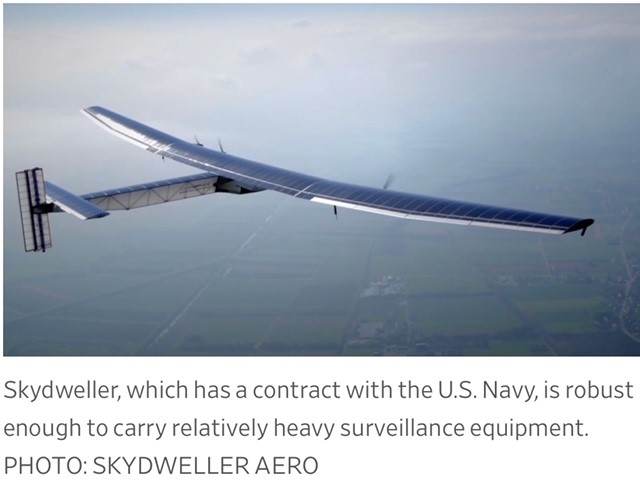
The complete article can be accessed here: Solar-Powered Planes Take Flight
Excerpt from the Wall Street Journal:
THE FUTURE OF EVERYTHING – Solar-Powered Planes Take Flight
The light, uncrewed aircraft could provide surveillance and telecommunications that balloons and satellites can’t—and stay aloft for months
By Phred Dvorak, Wall Street Journal
June 10, 2024 at 9:00 pm ET
Imagine airplanes powered only by energy from the sun, some so light they can be launched from the ground by hand, others gathered in giant “parking lots” in the stratosphere.
Those are the types of aircraft being developed now that are bringing the dream of solar- powered flight closer to reality, with planes that act very differently from the jetliners of today.
Solar-powered planes won’t be flying people to their next vacation spot anytime soon. But these prototypes, most of which operate without humans, could lead to new alternatives for aerial surveillance on high-risk missions and emergency telecommunications in disaster zones, industry executives say. Aviation giants, telecommunication companies, venture investors and military agencies are already spending millions of dollars developing the planes and their technologies.
“It’s like in the early days of aviation” as companies, governments and investors try to figure out what these planes can do and what could be economically viable, says Eric Raymond, a solar-aircraft designer and glider pilot who started experimenting with solar-powered flight in 1979. “The potential is there, I do believe in it after all these years.”
Solar aircraft typically soak up the sun’s energy via panels that cover the wings—and sometimes the body, sides and tail as well. The advantage of solar power is that it is free and emissionless—much more environmentally friendly than burning jet fuel. A solar plane never needs refueling, and in theory it can stay in the air as long as the sun is shining. That brings perpetual flight within reach, if the solar is paired with batteries that charge during the day and power the aircraft and its payload at night.
Advances in battery technology and cost have finally made it feasible to power a solar plane for longer distances or through the night, solar-aircraft executives say, albeit with much less power than jet fuel, pound for pound. That means today’s solar aircraft are extremely lightweight and slow. Many fly around the speed of a slow car. They have trouble withstanding bad weather. Most can’t carry heavy loads.
The planes have some advantages over current aircraft used for services like surveillance.
Most of the companies trying to commercialize solar planes are building aircraft that are lightweight, autonomous and can fly at altitudes and for lengths of time that humans can’t tolerate. Unlike balloons, solar planes are steerable, a big advantage for monitoring a target on the ground or providing telecom coverage without being blown off course. They are also cheaper and closer to Earth than satellites, putting them in a sweet spot for services that can’t currently be offered by either, executives in charge of solar-aircraft projects say.
The planes can capture higher resolution photos or video than satellites, or deliver broadband internet from the air, another thing satellites can’t do. Executives envision programming them to fly to the other side of the globe on surveillance missions that last months, making them a safer and longer-term alternative to monitoring by piloted planes. Solar aircraft could be sent to disaster zones to provide emergency telecommunications then flown away when they are no longer needed.
Aerospace engineer and military drone designer Robert Miller says he first became interested in solar-powered airplanes several years ago, when the U.S. Defense Advanced Research Projects Agency, or Darpa, asked him to come up with a surveillance craft that could locate Joseph Kony, an African warlord accused of kidnapping and killing thousands of people in northern Uganda.
To do that, Miller figured he would need an aircraft that could travel long distances to a specified location and hang around for weeks at a time—something satellites in orbit can’t do—carrying a special radar that can track movement under the dense jungle canopy where Kony was believed to be hiding.
He landed on the Solar Impulse 2, a Swiss single-seater solar-powered plane with a wingspan as broad as a jumbo jet, which had recently become the first to circumnavigate the globe in 2016.
Miller started a company, bought the Solar Impulse 2 and retrofitted it to fly without humans, snagging a $5 million contract from the U.S. Navy along the way. The aircraft, renamed Skydweller, is flying test flights out of Mississippi, and the company is building a second that Miller hopes to have ready for delivery next year. It is heavier and can carry more than most of the other solar-plane prototypes, and flies at the same altitude as commercial airplanes.
One of the biggest challenges, Miller says, is ensuring the plane is robust enough to withstand winds and weather while it stays aloft for a targeted 90 days at a time.
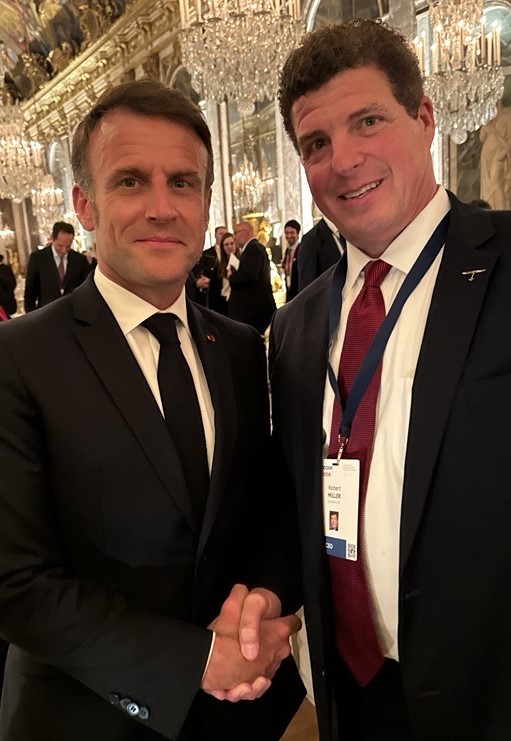
Oklahoma City, OK (May 13, 2024) — Skydweller Aero, Inc., Founder and CEO, Dr. Robert H. Miller met with French President Emmanuel Macron and his Ministers on May 13th to discuss how the company’s large capacity, autonomous solar-powered aircraft can perform civil, commercial and defense-related missions for the French government working with French industries.
The meeting occurred at the Château de Versailles during the 2024 Choose France summit, the country’s annual exclusive flagship business and strategy conference. President Macron personally invited Dr. Miller to attend the event.
“I am honored to have had the opportunity to speak with President Macron and his Ministers. I look forward to pursuing follow-on discussions with French government and industry officials about strategic cooperation between Skydweller Aero and France’s public sector and high-tech industries,” Dr. Miller said. “From monitoring illegal activities offshore, to mitigating natural disasters within the homeland, the innovative capabilities of our aircraft can help protect France, the French people, and its global interests.”
Established in 2018, Choose France promotes the country’s economic attractiveness and encourages international investment in and cooperation with France by gathering hundreds of leaders from the world’s largest multinational corporations. Since 2018, the event has generated more than 50 billion Euro in direct foreign investment.
About Skydweller Aero Inc.
Skydweller Aero Inc. is a pioneering transatlantic aerospace company developing and manufacturing a fleet of large capacity solar-powered autonomous aircraft capable of achieving perpetual flight while carrying a tremendous amount of payload. Our aircraft are manufactured from carbon-fiber – each with a wingspan similar to a 747 jumbo jet – and because they are solar powered, they are inexpensive to operate and maintain and feature zero carbon footprint.
With a flexible payload system, including communications relay, 4G/5G cellular, day/night full motion video, satellite communication, imaging radar, and more, these aircraft will be used for long duration missions such as providing continuous coverage above war zones, surveilling naval activity in contested waters, and detecting drug smugglers and pirates at sea. They will enhance commercial and government telecommunication, geospatial, meteorological and emergency operation efforts around the world, allowing customers to operate persistently in more challenging areas for longer durations, while reducing environmental impact.
Skydweller Aero Inc. has World and US headquarters in Oklahoma City and European offices headquartered in Spain.
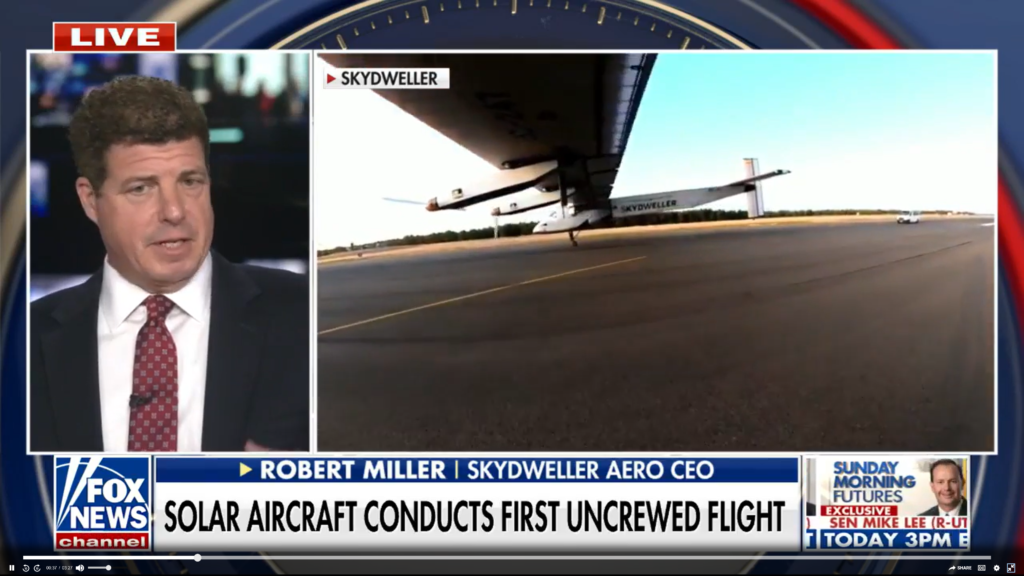
Fox News Live interview of Skydweller CEO Robert Miller: Solar-powered, uncrewed flights are the ‘future’ of aviation
April 21, 2024