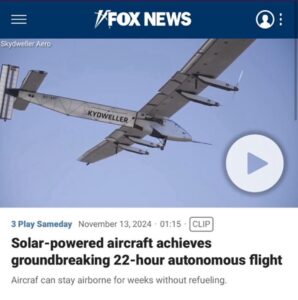
FOX’s CyberGuy Features Skydweller Aero
Solar-powered aircraft achieves groundbreaking 22-hour autonomous flight
How perpetual flights could soon be reality
Imagine an aircraft that can stay airborne for weeks, even months, without refueling. This isn’t futuristic fantasy.
Skydweller Aero is working toward turning this vision into reality with its innovative solar-powered plane.
As the world’s largest unmanned solar-powered aircraft, Skydweller is pushing the boundaries of what’s possible in aviation.
The Skydweller advantage
What sets Skydweller apart from its predecessors? Its foundation is built on the Solar Impulse, the first solar-powered aircraft to circumnavigate the globe. This heritage provides Skydweller with a robust design capable of carrying substantial payloads. With a wingspan of 236 feet (larger than a 747) and weighing just 5,620 pounds (about the same weight as a Ford F150), the Skydweller can carry up to 800 pounds of payload.
A milestone achievement
Skydweller Aero recently achieved a significant milestone by completing a series of uncrewed autonomous flight tests. The longest of these flights lasted an impressive 22½ hours, launched from the company’s facility at Stennis International Airport in Kiln, Mississippi. This achievement demonstrates the feasibility of remaining airborne for extended periods using solar energy and batteries.
Kurt’s key takeaways
As the world’s largest unmanned solar aircraft, Skydweller Aero is revolutionizing aviation and opening up exciting new possibilities. From enhancing maritime patrols to serving as airborne communication platforms, the potential applications are vast.
Watch / read FOX’s CyberGuy Feature Skydweller Aero:
Link to video – https://www.foxnews.com/video/6364663907112
Link to article – Solar-powered aircraft achieves groundbreaking 22-hour autonomous flight | Fox News Video

Skydweller Aero Can Help Defend Against Chinese Fishing Fleet Encroachments
The Wall Street Journal has revealed how Chinese fishing fleets are impacting the fishing industry of Peru and other vulnerable countries globally, threatening both local communities and national economies.
For developing nations, maritime domain awareness is vital for protecting sovereignty, sustaining economies, and supporting long-term environmental health.
Effective surveillance and response capabilities are crucial in guarding against overfishing and illegal activities within under-regulated exclusive economic zones.
Skydweller Aero is committed to advancing persistent surveillance solutions that enhance real-time situational awareness across vast maritime territories. For enforcement to be effective, agencies need photos of fishing boats with nets in the water, and the ability to identify those vessels.
Agencies need Skydweller.
Our innovations in solar-powered, autonomous aircraft empower countries to protect their resources and secure their maritime interests.
China’s Massive Fishing Fleet Overwhelms Locals in ‘David and Goliath’ Battle – WSJ
Mississippi Governor Recognizes Aerospace Industry Intern On His Social Media

“Last year, Xander McGarrity graduated from Hancock High School and landed an awesome job at Skydweller Aero! He recently represented Skydweller at his old high school to let students know about the exciting aerospace jobs in Mississippi. Thanks, Xander!”
Xander has the potential to be a great engineer in the future. We are fortunate to have him, his drive and energy working with us. This is what Skydweller Aero is about: innovative engineering, technology, and workforce development
https://x.com/tatereeves/status/1848832454502633651

Skydweller Aero Incorporated has come to an agreement with NASA Stennis Space Center to use restricted airspace for test flights.
“It was a challenge because they had a lot of different scenarios based on their requirements,” said Jason Peterson, Range Operations Manager at NASA Stennis Space Center. “They pushed the envelope so to speak, but we were able to overcome that with our team.”
With this access, Skydweller will be able to perform test flights in a controlled airspace with limited obstacles, allowing for less hiccups as they work on developments.
“This is developing technology that’s going to connect the unconnected from a digital perspective, and make the world a safer, more connected place,” said Robert Miller, CEO of Skydweller.
The aircraft Skydweller flies is different from your typical plane. This plane is manned by a remote pilot and powered by solar power, allowing for less carbon emissions and extended flight times.
“Conventional unmanned aircrafts fly for 40-80 hours tops,‘ said Miller. ”We’re talking about flying for weeks, months, so hundreds and thousands of hours we’d be in the air.”
With this agreement, the expected speed for findings should increase greatly, allowing for the newest breakthroughs in aviation technology to be found here in South Mississippi.
“This is technology that people in Silicon Valley failed at that were succeeding in in Mississippi and Oklahoma,” said Miller.
Aviation agreement to bring new tech breakthroughs to the Gulf Coast
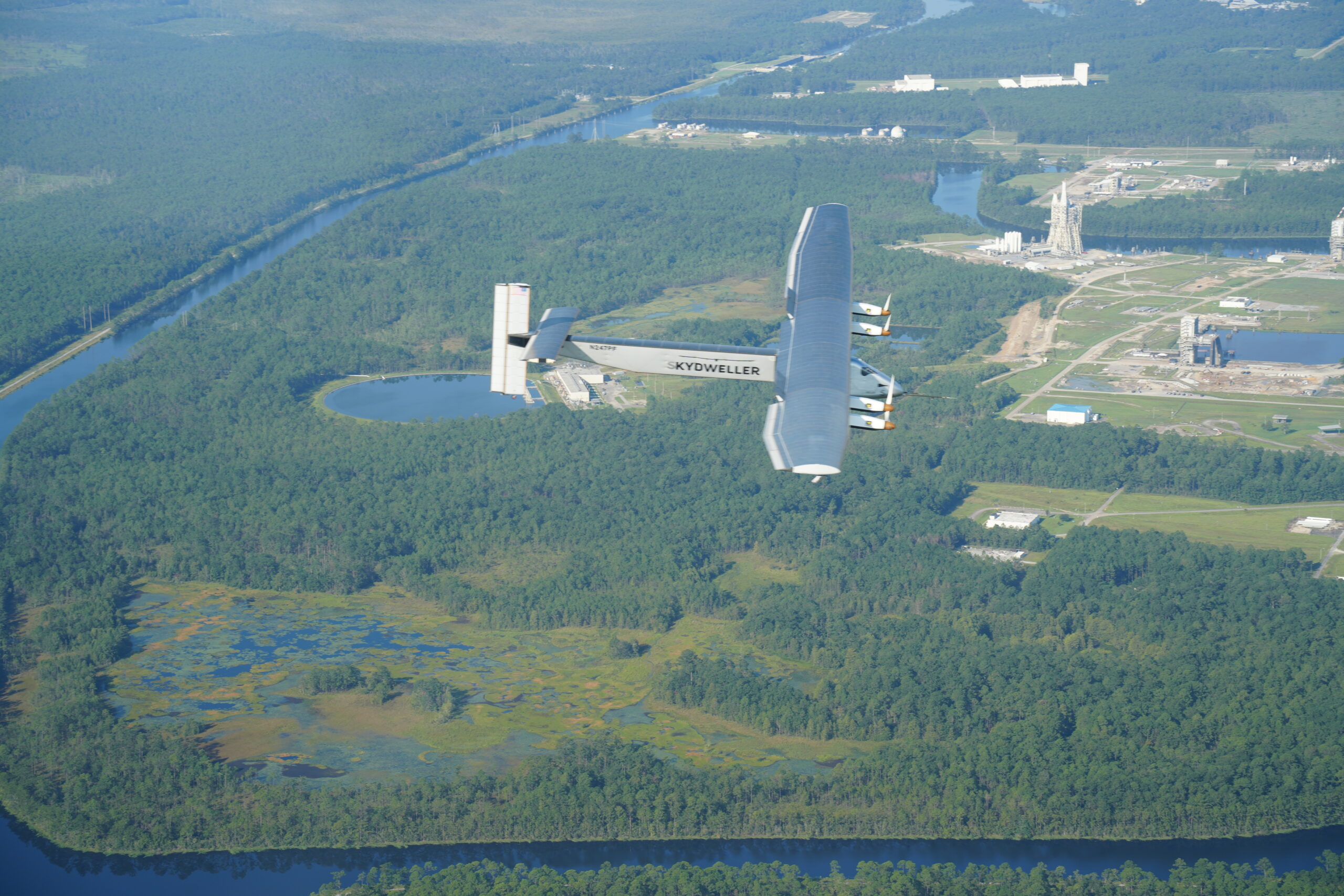
NASA’s Stennis Space Center and Skydweller Aero enter agreement for company to operate its solar-powered autonomous aircraft in the site’s restricted airspace, a key step towards Stennis achieving a strategic goal.
NASA’s Stennis Space Center near Bay St. Louis, Mississippi, has entered into an agreement with Skydweller Aero Inc. for the company to operate its solar-powered autonomous aircraft in the site’s restricted airspace, a key step towards achieving a strategic center goal.
The Reimbursable Space Act agreement marks the first between NASA Stennis and a commercial company to utilize the south Mississippi center’s unique capabilities to support testing and operation of uncrewed systems.
“There are few locations like NASA Stennis that offer a secure location, restricted airspace and the infrastructure to support testing and operation of various uncrewed systems,” said NASA Stennis Director John Bailey. “Range operations is a critical area of focus as we adapt to the changing aerospace and technology landscape to grow into the future.”
NASA Stennis and Skydweller Aero finalized the agreement in late August, paving the way for the company to begin area test flights of its autonomous, uncrewed solar-powered aircraft, which features a wingspan greater than a 747 jetliner and is designed for long-duration flights.
“Access to the restricted airspace above NASA Stennis has been tremendously helpful to our uncrewed, autonomous flight operations,” said Barry Matsumori, president and chief operating officer of Skydweller Aero. “The opportunity to use the controlled environment above Stennis helps accelerate our efforts, allowing us to transition the aircraft in and out of civil airspace, while demonstrating its reliability and unblemished safety record to the FAA.”
The agreement provides the company Federal Aviation Administration (FAA) authorization for future test flights in designated areas of the NASA Stennis buffer zone. It also represents a key step in the center’s effort to grow its range operations presence.
NASA Stennis Takes Key Step in Expanding its Range Operations Work – NASA
Skydweller over NASA Stennis Space Center
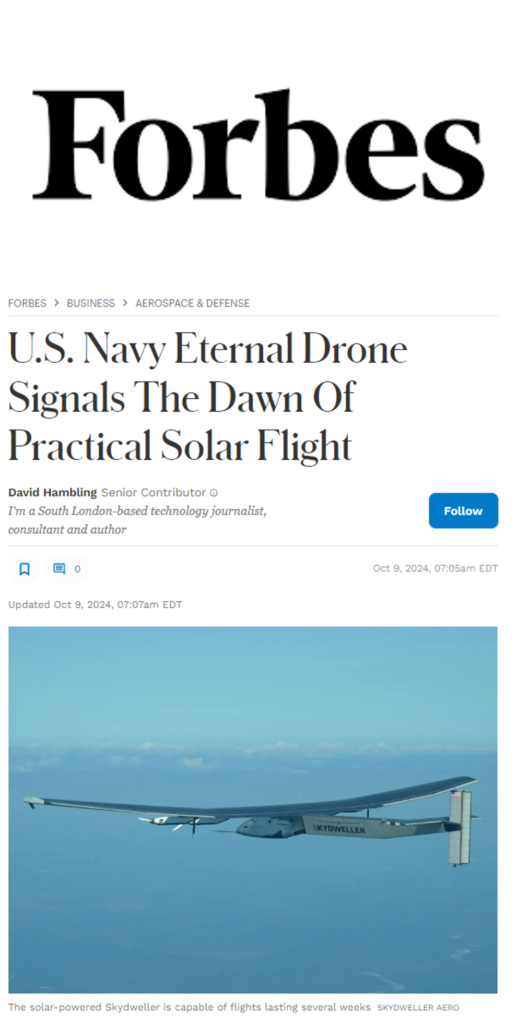
A Skydweller solar-powered drone just successfully completed a series of test flights with U.S. Navy funding. This time the longest flight was ‘just’ 22.5 hours, but in operation the aircraft will fly patrol missions lasting for weeks, powered by solar cells in the day and batteries at night.
The road to solar aircraft with effectively unlimited endurance has been a long one, littered with the flimsy fragments of failed projects. The Navy is finally closing in on an important new capability, one that could transform its long-range, long-endurance missions – and kickstart a whole new field of commercial aviation.
Made of lightweight carbon fiber, Skydweller has a wingspan of 236 feet (72 meters) but weighs just 5,620 pounds (2,550 kilograms), less than many light aircraft, with up to 800 pounds of payload. Robust, flexible wings are essential.
“In this field you need to really understand what it means to fly large flexible structures,” Skydweller Aero CEO Robert Miller told me. “If the people who are developing it do not understand aeroelasticity you can get wings popping off.”
Skydweller is strong and flexible enough to survive where others have literally disintegrated.
In principle building a perpetual solar aircraft is easy. Just find a lightweight powered glider, cover the wings with solar cells and add electric motors and batteries. In practice it is far from simple. The big, fragile aircraft are prone to break apart when hit by turbulence or other stresses encountered while getting to and from the stratosphere, a challenge has defeated some of the best in the business.
“There is ‘death zone’ for these aircraft from five to thirty thousand feet,” says Miller, and aircraft behave in complex ways. “Aerodynamics scale, but aeroelastics don’t.”
NASA failed. Its groundbreaking solar-powered HELIOS prototype flew to over 90,000 feet in 2001, but broke up in midair in 2007, and the project was terminated.
Boeing and DARPA failed. After Boeing won an $89m contract for their Solar Eagle aircraftfrom DARPA, they ran into difficulties and the program ended in 2012, with DARPA abandoning flight tests in favor of basic research into energy management.
Google failed. Their Solara 50 was supposed to provide internet connectivity to remote areas, but during flight tests crashed shortly after takeoff in 2015. The aircraft suddenly gained speed and “the left outboard wing section separated from the aircraft” according to an NTSB report. Google gave up with the project shortly afterwards.
Facebook failed. Their Aquila was another project intended to provide internet from the skies, but a prototype a broke up in mid-air in 2016. While Aquila was coming into land, a sudden gust of wind caused the right wing to break off. The Aquila program did not recover and was canceled in 2018.
Skydweller Aero started with two big advantages over the others. One is that it is derived from the Solar Impulse crewed aircraft which flew around the world in 2016. While other solar aircraft only carry a few pounds, Solar Impulse had a crew capsule weighing several hundred pounds, meaning it was built with safety in mind and had plenty of capacity when it was converted to uncrewed operation. The other advantage is the level of expertise.
“Fundamentally, my team has a lot more experience in aeroelasticity than all the other solar programs combined,” says Miller. “ Sometimes they don’t know what they don’t know. My team has worked on aircraft that have a million plus hours in the stratosphere.”
This expertise has produced a robust, reliable aircraft suitable for military service.
Solar Flight Plan
Miller says that the recent flight tests collected all the data they needed to validate the result of simulations. The campaign was sustained by funding from Naval Air Warfare Center Aircraft Division (NAWCAD) to evaluate autonomous maritime patrol aircraft.
The next stage will involve flying with the sensors and communications that the aircraft will use in operation with the Navy.
“In the winter we’ll be flying short flights of 15 to 20 hours in the Gulf of Mexico and the Caribbean with full U.S. Navy payloads, to demonstrate the utility of the system and how we can collect and distribute data,” says Miller. “In the Spring we will be flying 7-to-15-day flights, which is when our objective will be fully achieved.”
Skydweller Aero gives the Navy an aircraft with unprecedented endurance. Their current long-range drone is the MQ-4C Triton, a conventionally-fueled aircraft with an endurance of 30 hours. But this type of aircraft is expensive buy and expensive to fly, costing an estimated $35,000 per flight hour to operate — or a million dollars for a 30-hour mission. The Skydweller is far cheaper, with no fuel requirement and very little maintenance — “It’s flight hours per maintenance hour, rather than maintenance hours per flight hour,” says Miller.
Even with recent upgrades, Skydweller Aero is not pushing the limits of what is technologically possible for this type of aircraft.
“The fly-by-wire control system has been upgraded and it is now fully redundant with no single point of failure. The batteries have been upgraded to the state-of-the art of what is now in production,” says Miller. “We will shortly be upgrading the engines with high efficiency motors that have magnetic gearboxes, that will bring ultra-reliability and about an 8-10% increase in efficiency.”
Solar aircraft benefit from being at the intersection of several technologies, all of which are improving.
“There has been a lot of growth in the technology in general, “says Miller. “With massive industry investment in solar, in batteries and in motors. The water is rising and all the boats are rising with it.”
That rise could enable a whole new solar-powered aviation industry.
Commercial Future
Skydweller will initially be a military project, carrying a variety of Navy sensors (typically radar) and communication packages. As we previously noted, a suite of AI software from Palantir will handle, fuse and analyze complex data collected by the sensors. Rather than beaming back gigabytes of video of empty ocean, Skydweller only needs to communicate when it sees a ship or other item of interest
But as Google and Facebook had observed, long-endurance solar aircraft also have tremendous commercial potential as airborne communications platforms.
“The military will be early adopters of this technology, and we can grind out the rough edges with them before we roll out to a wider base,” says Miller. “It is very much like satellite communications, where the military were early adopters. They burned down the risk and the market took off, now it is 99% commercial.”
Miller sees solar aircraft as a complementary capability to LEO satellite communications rather than a direct rival. In certain parts of the world — Miller mentions specific regions his team have looked at — the economics could favor a network of solar aircraft circling overhead to provide continuous coverage.
At present Skydweller Aero just have one aircraft but demand is likely to drive production.
“We hope to start building another aircraft next year, and then several more after that,” says Miller.
After that, production could accelerate rapidly into big numbers. Lightweight aircraft with no jet engines can be manufactured quicker than airliners or other aircraft.
There is a commercial rival in the form of the Zephyr series made by Airbus, a type which has been under development for more than 20 years. This is a smaller, lighter aircraft; the Zephyr 8 has an 82-foot wingspan and carries a payload of about 11 pounds compared to 800 pounds for Skydweller. Zephyr is marketed as a potential “flying cellphone tower” but the project has experienced difficulties. Three aircraft have been lost, the latest in an accident in June 2022 when, like so many others, it broke up in mid-air.
In solar aviation, only the strong survive. And Skydweller, originally built to be robust enough to carry human pilots safely, looks like the strongest drone in the field. After decades of dead ends, solar aviation may finally be taking off.
U.S. Navy Eternal Drone Signals The Dawn Of Practical Solar Flight (forbes.com)
Share the joy and triumph of our recently completed flight test campaign by watching this Skydweller Aero video, available here
Social Media Influencer “Papa Mississippi” is a proud Mississippian.
He is so happy that Skydweller Aero flies from Stennis International Airport in Kiln that he made this video.
Enjoy!

The Oklahoma-headquartered firm on 30 September said the Skydweller UAS successfully conducted a series of autonomous long-duration flights in recent weeks, including one sortie lasting 22h 30min and another spanning 16h.
SkyDweller Aero completes tests of ultra-long-endurance solar aircraft | News | Flight Global
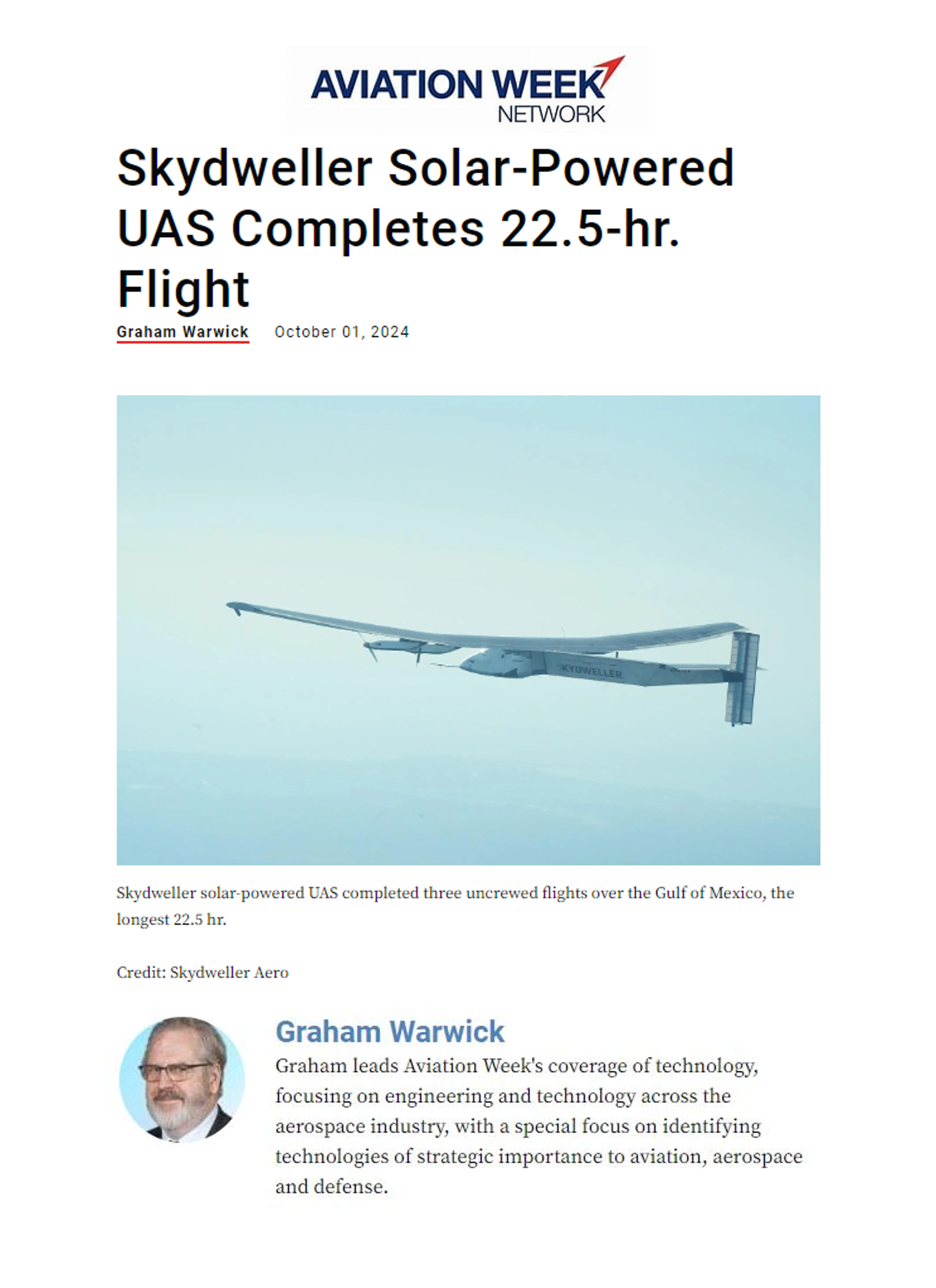
The complete article can be accessed here (subscription required): Skydweller Solar-Powered UAS Completes 22.5-hr. Flight | Aviation Week Network
Excerpted from Aviation Week:
…the Sept. 22 mission demonstrated the feasibility of staying airborne for weeks to months on solar power and batteries. “The data gathered validates our model for multiday flights,” co-founder and CEO Robert Miller says.
The flights also showed the aircraft’s ability to fly in operationally relevant weather. “We’re not flying in Yuma in July. We’re flying over the Gulf Coast in hurricane season,” he says, referring to previous record-setting solar-powered UAS flights conducted over Yuma Proving Ground in Arizona.
Autonomous flights with no pilot on board began with a 3-hr. 10-min. mission on. Sept 14. A 16-hr. 11-min. flight followed on Sept 19-20 and led up to the 22-hr. 22-min autonomous flight on Sept 21-22. The flight was cut short because of the risk of high winds from the approaching Hurricane Helene.
“We got plenty of data from the 16-hr. and 22.5-hr. flights that shows we can do perpetual flight,” Miller says. Another reason for truncating the final mission was the aircraft is flying on new, high-performance batteries, leading to concerns about performance at low voltage after powering the aircraft through the night. But the flight showed “we have more margin than we thought we had,” he says.
The longer flights also demonstrated the aircraft ’s redundancy and turnaround between missions. A circuit breaker failed early on the 16-hr. flight, but the system redundancy handled the failure correctly and the aircraft flew on for another 13 hr., Miller says. The breaker was replaced aft er landing and a day later the aircraft was launched again. “We put a new one in and it flew for 22.5 hours,” he says.
The flights also showed the aircraft ’s ability to operate in the vicinity of weather, as the 16-hr. flight was conducted with developing thunderstorms in the area. “This shows we can fly in an operationally relevant environment,” Miller says. This supports the Skydweller UAS’ use for long-duration missions from the U.S. over the Caribbean and West Africa where the Pentagon does not have forward bases.
Because of its size…the Skydweller UAS can carry heavier payloads than other solar-powered and most medium-altitude uncrewed aircraft. The aircraft is flying with two line-of-sight data links and three satellite communications systems—Iridium, Inmarsat and Skylight—with a fourth to be added. “That’s a lot of capacity,” he says.