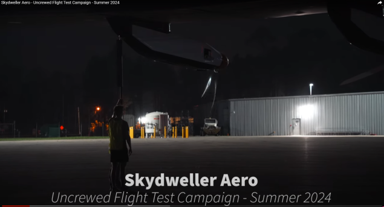
Share the joy and triumph of our recently completed flight test campaign by watching this Skydweller Aero video, available here
Social Media Influencer “Papa Mississippi” is a proud Mississippian.
He is so happy that Skydweller Aero flies from Stennis International Airport in Kiln that he made this video.
Enjoy!
The complete article can be accessed here (subscription required): Skydweller Solar-Powered UAS Completes 22.5-hr. Flight | Aviation Week Network
Excerpted from Aviation Week:
…the Sept. 22 mission demonstrated the feasibility of staying airborne for weeks to months on solar power and batteries. “The data gathered validates our model for multiday flights,” co-founder and CEO Robert Miller says.
The flights also showed the aircraft’s ability to fly in operationally relevant weather. “We’re not flying in Yuma in July. We’re flying over the Gulf Coast in hurricane season,” he says, referring to previous record-setting solar-powered UAS flights conducted over Yuma Proving Ground in Arizona.
Autonomous flights with no pilot on board began with a 3-hr. 10-min. mission on. Sept 14. A 16-hr. 11-min. flight followed on Sept 19-20 and led up to the 22-hr. 22-min autonomous flight on Sept 21-22. The flight was cut short because of the risk of high winds from the approaching Hurricane Helene.
“We got plenty of data from the 16-hr. and 22.5-hr. flights that shows we can do perpetual flight,” Miller says. Another reason for truncating the final mission was the aircraft is flying on new, high-performance batteries, leading to concerns about performance at low voltage after powering the aircraft through the night. But the flight showed “we have more margin than we thought we had,” he says.
The longer flights also demonstrated the aircraft ’s redundancy and turnaround between missions. A circuit breaker failed early on the 16-hr. flight, but the system redundancy handled the failure correctly and the aircraft flew on for another 13 hr., Miller says. The breaker was replaced aft er landing and a day later the aircraft was launched again. “We put a new one in and it flew for 22.5 hours,” he says.
The flights also showed the aircraft ’s ability to operate in the vicinity of weather, as the 16-hr. flight was conducted with developing thunderstorms in the area. “This shows we can fly in an operationally relevant environment,” Miller says. This supports the Skydweller UAS’ use for long-duration missions from the U.S. over the Caribbean and West Africa where the Pentagon does not have forward bases.
Because of its size…the Skydweller UAS can carry heavier payloads than other solar-powered and most medium-altitude uncrewed aircraft. The aircraft is flying with two line-of-sight data links and three satellite communications systems—Iridium, Inmarsat and Skylight—with a fourth to be added. “That’s a lot of capacity,” he says.
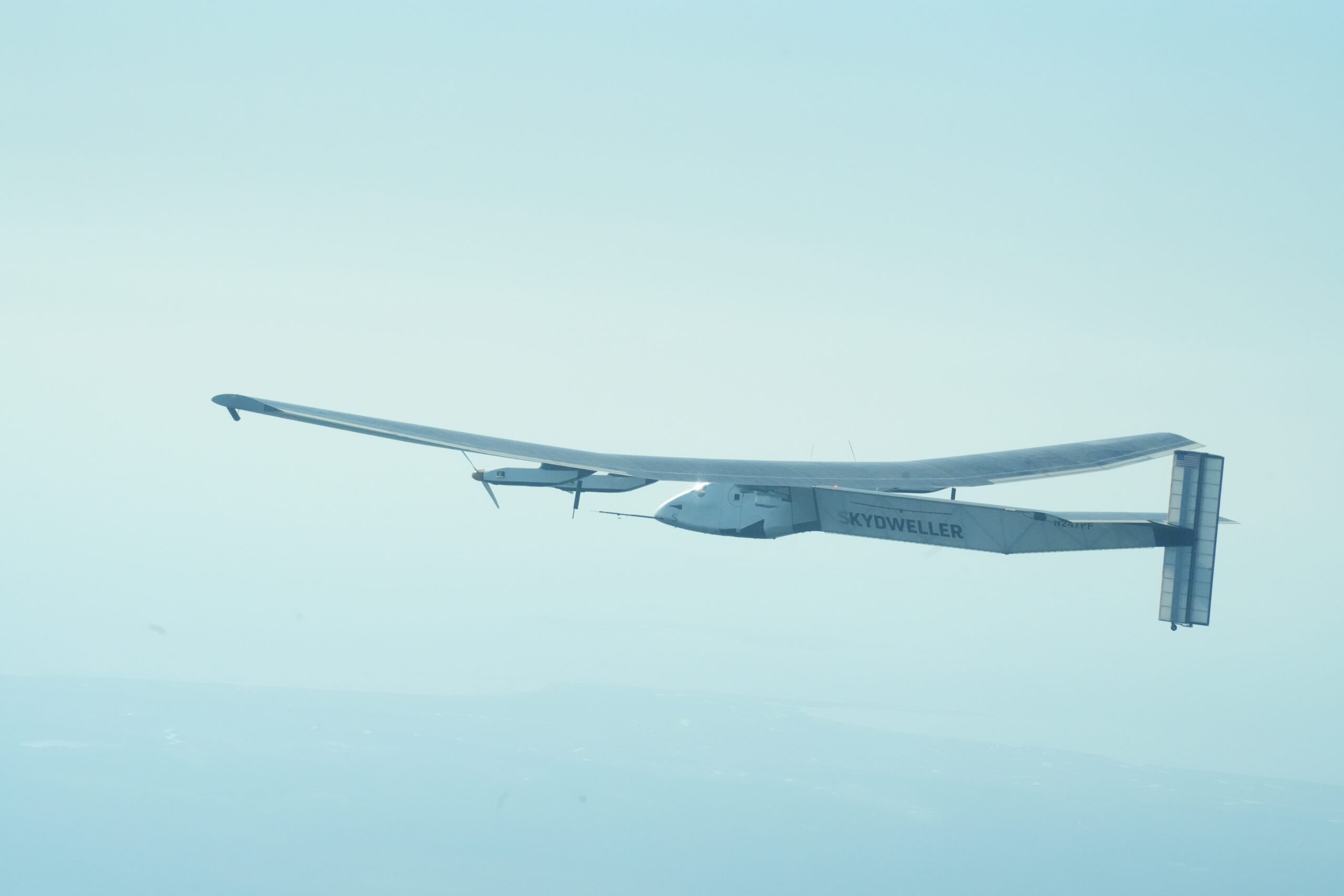
OKLAHOMA CITY | 1 October 2024 – Skydweller Aero has successfully completed the uncrewed autonomous flight test campaign of its Skydweller Unmanned Aerial System. A series of uncrewed flight tests – with the two longest being 16 hours and 22 ½ hours – were launched from the company’s facility at Stennis International Airport in Kiln, Mississippi.
This campaign is one more step towards bringing extreme flight endurance to the world, demonstrates the feasibility of remaining airborne for weeks to months using solar energy and batteries, and is another significant milestone in the development of the Skydweller aircraft and its high reliability autonomous vehicle management system.
This campaign was initiated under a Joint Concept Technology Demonstration (JCTD) by the Office of the Undersecretary of Defense for Research & Engineering (OUSD R&E) and sustained by a Cooperative Research & Development Agreement (CRADA) with the Naval Air Warfare Center Aircraft Division (NAWCAD) to evaluate Autonomous Maritime Patrol Aircraft (AMPA).
Dr. Robert Miller, Chief Executive Officer and co-founder of Skydweller Aero, said: “This flight test campaign is an important achievement and validates our business vision, marking a new era in autonomous aviation. Skydweller Aero is redefining what is possible in the aerospace industry, and the data gathered that validates our models for multi-day fights is a testament to our team’s dedication and innovation. We are excited to continue pushing the boundaries of what uncrewed solar-powered aircraft can achieve and will continue on with our mission to bring perpetual flight to the world.”
Barry Matsumori, President & Chief Operating Officer of Skydweller Aero, said: “We have accomplished a major milestone toward demonstrating the feasibility of perpetual flight by leveraging the trillions of dollars in global research and development investment in solar energy, battery storage, and the handing and manufacturing of extremely strong, ultra lightweight carbon fiber assemblies. As these subsystems improve, we will continue to leverage them for the benefit of our customers.”
Highlights of the Flight:
- Uncrewed Autonomous Operation: At high operation tempo, the Skydweller aircraft conducted a series of long endurance flight tests demonstrating potential to perform extreme endurance missions.
- Solar-Powered Flight: Powered by solar energy, the aircraft delivers zero carbon emissions with ultra-quiet operations.
- High Reliability Autonomous Systems: The flight demonstrated uncrewed operation of Skydweller’s fully redundant autonomous systems and beyond-line-of-sight operations & communication.
About Skydweller Aero Inc.
Skydweller Aero Inc. is a pioneering transatlantic aerospace company developing a fleet of the world’s largest solar powered uncrewed aircraft capable of performing extreme endurance flights with heavy, powerful payloads. Skydweller autonomous all carbon fiber aircraft have a wingspan greater than a 747 and weigh about the same as a Ford F-150. Skydweller’s uncrewed aircraft will be used for ultra-long duration missions such as providing exclusive economic zone enforcement, monitoring naval activity, and detecting drug smugglers and pirates at sea. Skydwellers accomplish these missions with zero carbon footprint. Skydweller Aero Inc., backed by venture and private capital, has World and US headquarters in Oklahoma City and European offices headquartered in Spain. http://www.skydweller.aero
NOTE – A Digital Media Room with additional information, hi-res photos & videos is available here: Media Room
###

Our friends and neighbors at NASA’s John C. Stennis Space Center have spotlighted our relationship on their social media channels:
📘 Facebook: https://www.facebook.com/share/p/FYcpC47Rs9zwZmtA/
✖️ X: https://x.com/NASAStennis/status/1838935871711494493
🎥 YouTube: https://www.youtube.com/@NASAStennis/community
The Skydweller aircraft uses Stennis’s airspace when 🛫 climbing to and descending 🛬 from higher altitudes when flying between Stennis International Airport and its offshore destinations.
A big thank you to NASA for the shoutout, and for supporting Skydweller’s innovative aerospace technology!

As the world’s largest solar-powered aircraft looks to set off on its most ambitious mission to date – a trip to circumnavigate the globe – Aerospace Global News caught up with Robert Miller PhD, CEO and co-founder of Skydweller Aero, to find out more about the impetus behind the initiative.
Read the complete article at – Ultimate endurance: achieving solar-powered perpetual flight (aerospaceglobalnews.com)
Nik Coleman of Coleman Television produces “History’s Greatest Aircraft,” a series that looks at some of the most impressive technical marvels of engineering to have ever taken to the sky. Each episode delves into a different aircraft to analyze its service history and recount some of its most legendary stories.
Skydweller Aero is honored to have caught the attention of this award winning program’s creator during the 2024 Farnborough Air Show, and to share our story with him and his audience.

Seeing Skydweller in flight for the first time, some southern Mississippi folks enjoying themselves on the bayou made this video.
Even without a video, seeing Skydweller in flight for the first time is likely something they will never forget.
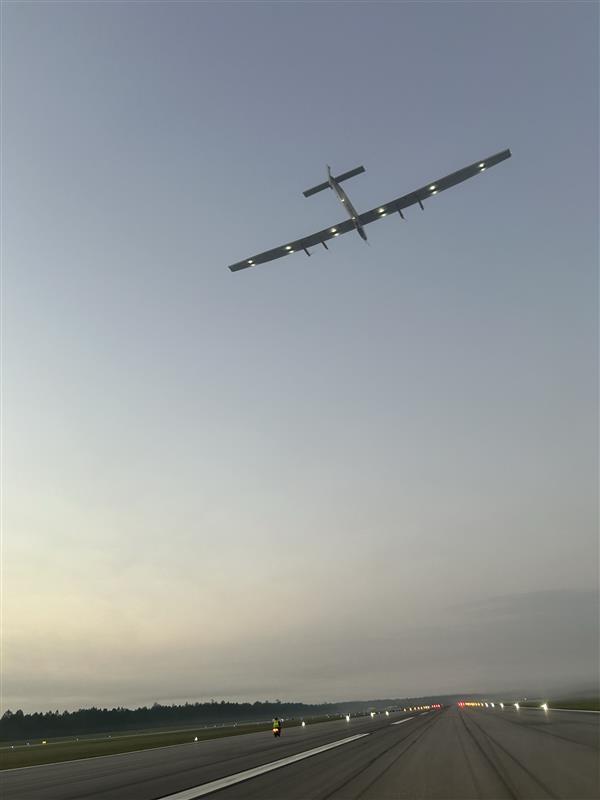
Skydweller is the world’s largest uncrewed, all-carbon fiber aircraft with a wingspan greater than a 747 and weigh about the same as a Ford F-150, capable of performing extreme endurance flights with heavy, powerful payloads. Skydwellers will be used for ultra-long duration missions such as providing exclusive economic zone enforcement, monitoring naval activity, and detecting drug smugglers and pirates at sea, and will accomplish these missions with zero carbon footprint.

Vetter Formerly Served as the Company’s Chief Engineer
20 August 2024 – Skydweller Aero, Inc. is excited to announce Travis Vetter, its Chief Engineer, has been appointed Chief Technology Officer (CTO). In his new position, Travis will spearhead Skydweller’s strategic utilization of innovative technologies to maintain competitiveness and achieve the company’s objectives.
“Travis brings a wealth of experience and a forward-thinking approach to technology that perfectly aligns with our mission to innovate and lead the autonomous solar aircraft industry. His leadership will play a pivotal role in advancing our technological roadmap, improving our product offerings, and ensuring our position as a frontrunner in industry advancements,” said Dr. Robert Miller, Chief Executive Officer and co-founder of Skydweller Aero. “I am confident that under his guidance, our technology team will continue to push boundaries, deliver exceptional value to our customers and partners.”
Travis, a longstanding member of Skydweller’s leadership team, previously served as a Chief Engineer for Special Programs at Northrop Grumman. In this role, he provided technical guidance to hundreds of engineers and oversaw millions of dollars in annual revenue. Before that, Travis held key technical positions at the Defense Advanced Research Projects Agency (DARPA), where he led various programs including the Tern program as the Air Vehicle, VMS, and Flight Controls lead, as well as serving as the Guidance Navigation & Control IPT Special Projects lead and Aeroelastic Controls lead for undisclosed projects.
Travis brings extensive expertise in aircraft design, UAV flight control, aeroelastic systems control, vehicle management systems, and mission systems integration. He holds two Bachelor’s degrees and a Master’s degree in Mechanical and Aeronautical Engineering from the University of California.

Complete article here: Skydweller outlines vision for perpetual, autonomous solar flight (simpliflying.com)
At the Farnborough International Airshow last week, Skydweller Aero revealed a significant milestone: the successful completion of the first autonomous flight by a large-scale solar-powered aircraft in the United States.
This achievement marks a step towards the company’s ambitious goal of continuous around-the-world flight, potentially revolutionising long-duration aerial missions.
Barry Matsumori, President and Chief Operating Officer of Skydweller Aero, summarised the company’s ambitious vision:
“We’re talking about going around the world non-stop, solar, so all green, and doing it uncrewed, unmanned, autonomously. Has anyone done that, all that combination of capabilities? The answer is no, not yet.”