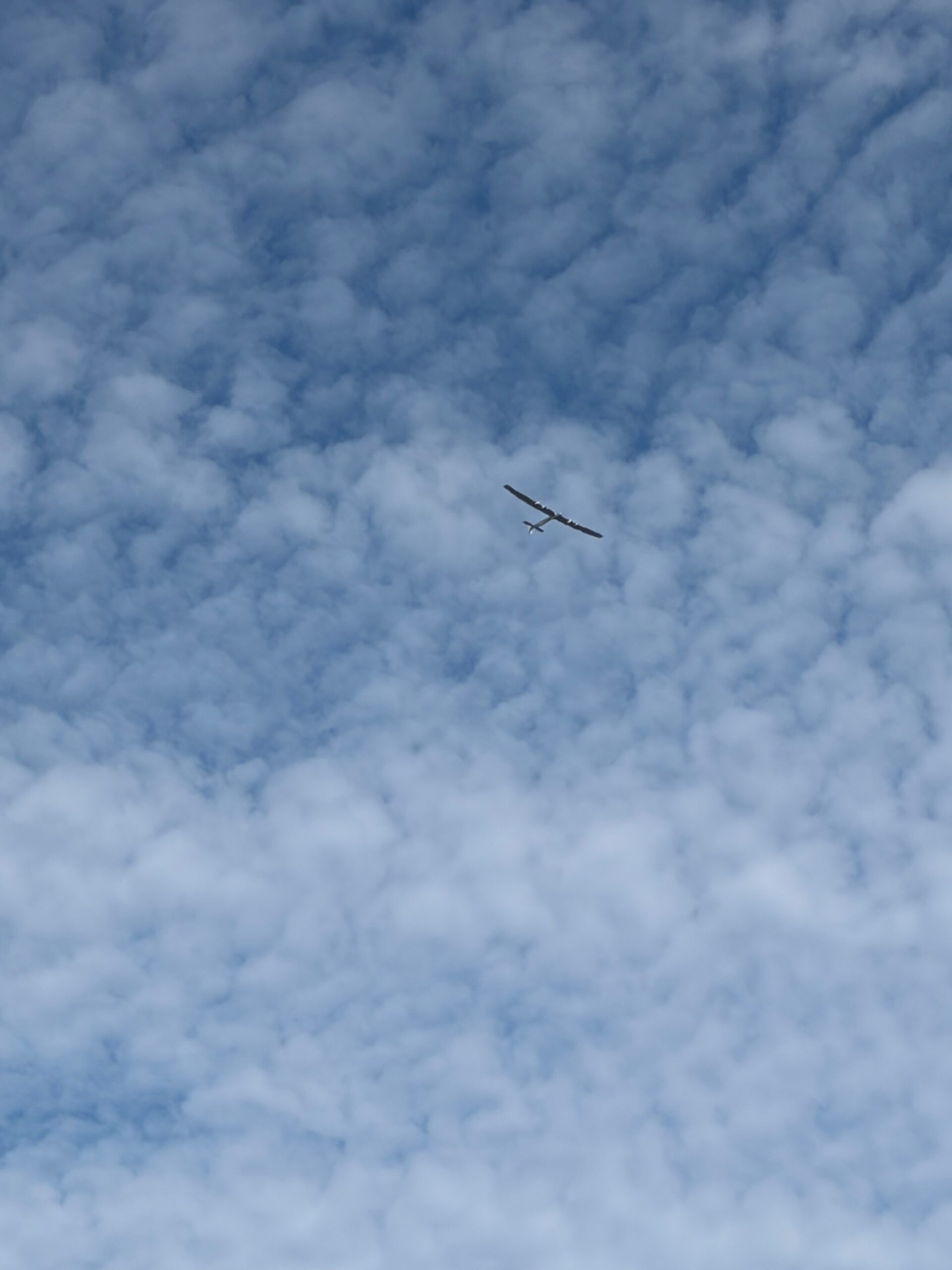
As part of its participation in the U.S. Navy’s Fleet Exercise (FLEX) 26, Skydweller Aero’s operational prototype aircraft conducted a historic 8-day (192-hour) and 14-minute autonomous maritime patrol flight. The aircraft departed Stennis International Airport in Mississippi on Sunday, April 26, and remained on station providing multi-INT sensor capability through the conclusion of the exercise on Thursday, April 30, before executing a controlled water ditching in the Gulf of America on Monday, May 4.
Skydweller Aero’s participation marked a significant milestone in the development of persistent, solar-powered autonomous maritime patrol capability. The aircraft completed more than four days of continuous flight within the FLEX 26 exercise environment, providing SAR tracks and EO/IR video supporting maritime mission contexts before the formal window concluded on April 30.
Following the exercise, the aircraft remained airborne to wait out a large cold front covering the Gulf. It held in the Key West area through Friday, May 1, before repositioning south of Cuba and north of the Cayman Islands. After 1½ days of weather-constrained loitering, a predicted window opened on Sunday, May 3, and a return to its base at Stennis was initiated.
During the return transit, the aircraft encountered more severe weather than forecast, including heavy turbulence and vertical drafts, causing climb and descent rates in excess of ten times typical rates. While the airframe and autonomy systems performed as designed, these conditions required more power than expected to maintain altitude, leading to a controlled ditch on the morning of May 4.
The aircraft completed a historic multi-day autonomous mission and supported Navy exercise objectives, executing a controlled ditching only after its energy reserves were depleted by sustained, extreme weather conditions. All aircraft structures, systems, and redundancies were nominal except battery energy levels.
Based on observed system status, the aircraft remained under positive control by its onboard autonomous system through the final flight phase.
No personnel were onboard, and no injuries were reported.
Investigation Status
The U.S. Navy and Skydweller are investigating all factors leading to the loss of the operational prototype. No final findings have been issued, and Skydweller will defer to official determinations as they are released. It is important not to prejudge causal factors while this formal process is underway.
Mission Timeline
Takeoff | April 26 (~06:15 AM):
Skydweller’s Autonomous Maritime Patrol Aircraft (AMPA), tail number N247PF, launched from Stennis and with a strong tailwind arrived at the Naval Air Station Key West / FLEX operating area that same night, ahead of schedule.
FLEX Operations | April 27 – April 30:
Within the U.S. Navy FLEX 26 exercise environment, the aircraft sustained autonomous maritime patrol operations. During this period, the aircraft demonstrated continuous autonomous flight and stable control over multiple days, even while operating in highly variable atmospheric conditions.
The mission successfully validated the integration of multiple payload systems in a suite supporting maritime domain awareness and ISR-relevant sensing. These payload operations included:
- Integration of multiple payload systems as a suite in support of maritime domain awareness.
- AN/ZPY-8 SAR track generation for target tracking. (Formerly used on MQ-8C).
- FLIR 380X HDc electro-optical/infrared imaging for target observation. (Formerly used on MQ-5B/C).
- AIS maritime tracking.
- Data Distribution to U.S. government-wide dissemination networks.
These results reflect mission-relevant system performance under real-world operational stress within a Navy exercise environment.
Post-FLEX Operations | May 1 – May 4:
After the FLEX 26 exercise window concluded, the operational prototype aircraft continued autonomous operations to validate its extreme-endurance Concept of Operations (CONOP) while awaiting suitable weather for the return transit.
During this period, the platform demonstrated extended operational and airspace flexibility within the SOUTHCOM area of responsibility. Through in-flight coordination with U.S. and international ATC centers, the system operated across coordinated corridors between Mexican and Central American ADIZ regions. This included positioning south of Cuba and north of the Cayman Islands for more than 1½ days as major weather systems moved through the region, extending total endurance beyond seven days of continuous flight.
Endurance Milestone | May 3:
The aircraft exceeded seven days of continuous flight, surpassing a key endurance benchmark within the mission profile and validating the platform’s capacity for persistent, multi-day operations.
Water Ditching Event | May 4 (~06:30 AM):
Overnight, the aircraft encountered significantly more severe weather than forecast, including extreme vertical air mass variability exceeding 10 times typical climb and descent rates. These severe conditions validated the platform’s fundamental design criteria, highlighting the robust build quality, system sizing, and the resilience of the airframe. Throughout these extreme conditions, the flight and autonomy systems performed nominally and as designed.
Under these conditions, usable onboard energy reserves became the limiting factor for continued flight, even as solar generation resumed after sunrise. This depletion occurred in the context of prolonged, severe environmental loading.
At flight termination, primary systems remained nominal, with propulsion, flight control, and airframe integrity intact through the final flight phase. Continued flight was constrained solely by the aircraft’s energy state.
A controlled water ditching was executed northwest of Cancun in the Gulf. Following the ditching, the aircraft subsequently sank due to its non-buoyant composite structure.
Public reporting
Some news reports have occasionally compressed the timeline or failed to distinguish between the successful completion of the mission demonstration and the subsequent controlled water ditching.
That distinction matters.
The aircraft was an operational prototype undergoing development and operationally relevant flight testing, not a production model. It did not experience a premature failure; rather, it completed more than eight days of autonomous operations and generated critical data during FLEX 26. The mission concluded only after sustained environmental loading depleted usable onboard energy reserves during the return transit.
What This Demonstrates
Skydweller demonstrated that extreme-endurance, solar-powered autonomous flight under real-world atmospheric conditions is operationally achievable. By carrying mission-relevant payloads within a Navy exercise environment and navigating across multiple international ADIZ regions, the platform validated the practical military utility of a persistent, medium-altitude solar aircraft.
The modern maritime environment presents persistent surveillance demands across vast geographic regions that exceed the capability of any single traditional platform class. The resulting gap is increasingly operationally significant:
- Satellites provide reach but not continuous dwell.
- Crewed aircraft provide flexibility but not endurance.
- Naval assets provide presence but not persistent coverage.
Skydweller addresses this critical coverage gap. By utilizing fuel-independent propulsion, it achieves sustained airborne operations over durations far beyond conventional aircraft –conducting intelligence, surveillance, reconnaissance, electronic warfare, communications, and maritime domain awareness missions.
Skydweller’s approach has successfully demonstrated this presence and persistence, proving the utility of a single platform carrying a suite of multi-INT payloads and sharing real-time data within a complex operational exercise.
On Frontier Aerospace Development
Development progress is best interpreted in the context of total system performance across the full mission envelope. With this flight, Skydweller demonstrated sustained autonomous operations across an extended, multi-day flight profile using an operational prototype aircraft under development. This milestone validates the platform’s ability to operate reliably in a mission-relevant environment while continuing to push the boundaries of frontier aerospace technology.
Finding boundaries and managing setbacks are integral parts of the development process; they are best interpreted in the context of total system performance across the full mission envelope.
Planned upgrades using existing technology will provide the performance necessary to withstand the extreme conditions encountered during this flight while delivering a significant increase in overall capability.
Onward & Upward
Skydweller’s trajectory remains unchanged and focused on delivering multi-sensor operational capability to its customers. The company remains committed to incorporating the operational lessons from this flight into the next phase of platform development to ensure mission success for future deployments.
While the aircraft, heavily modified from its original manned configuration, did not complete its full lifecycle, it successfully achieved its primary objective: demonstrating sustained, multi-day, solar-powered autonomous operations. This included executing multi-INT missions within a U.S. Navy exercise environment and navigating transits under real-world atmospheric conditions and international airspace constraints.
The mission termination reflected an energy-limited controlled descent under extreme environmental loading, rather than a loss of control or structural breakup.
Ultimately, a record-breaking flight of 8 days and 14 minutes validates the reality of perpetual, solar-powered flight in a military mission-relevant environment.
That achievement stands on its own.