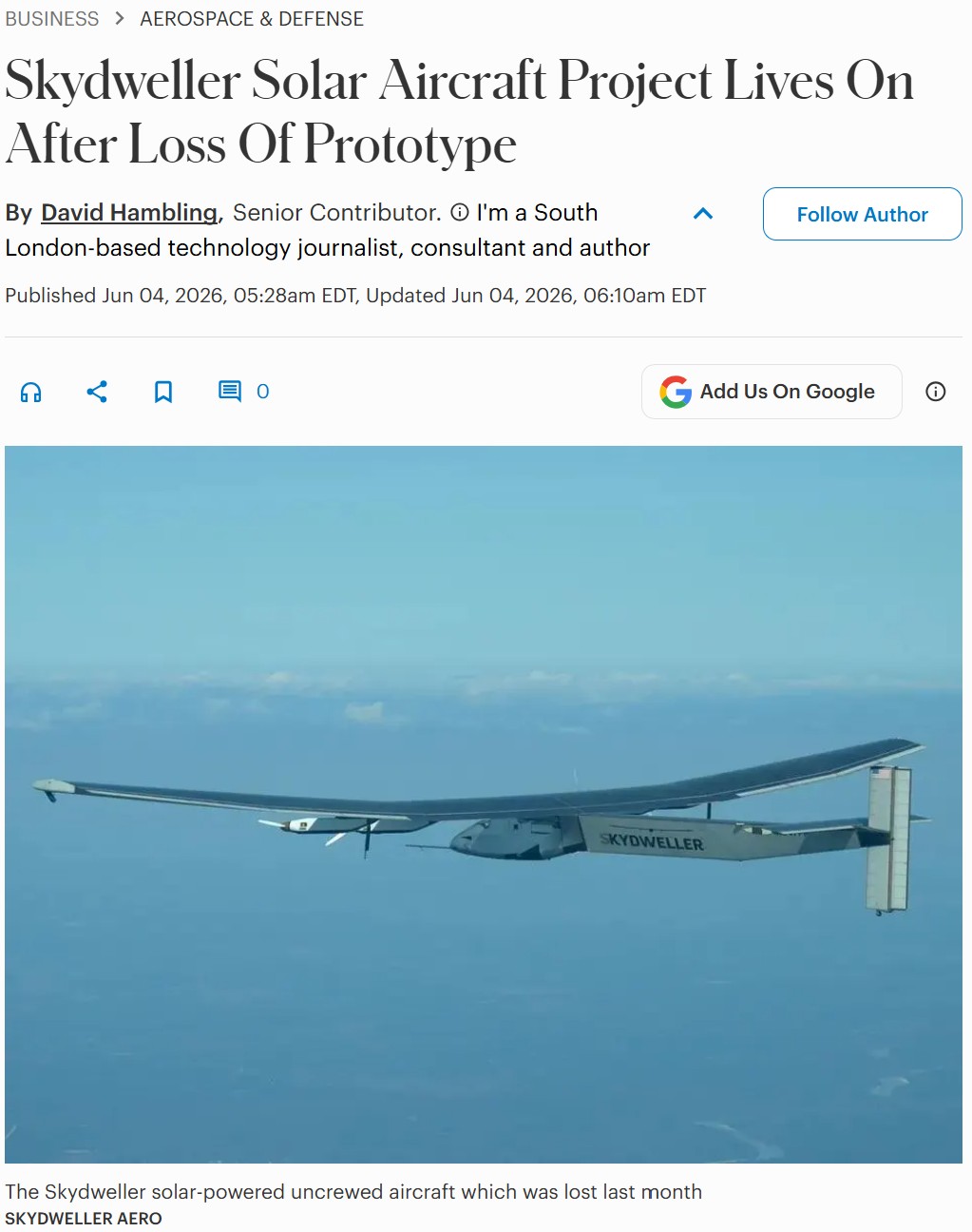
The Skydweller Solar Aircraft continues to demonstrate the value of ultra-persistent autonomous flight. A recent Forbes article highlights its operational performance during the U.S. Navy’s Fleet Exercise 2026 (FLEX 26), where it conducted long-endurance maritime surveillance and intelligence missions in a real-world environment.
Importantly, the mission demonstrates a key milestone for persistent ISR through sustained solar-powered flight in operational conditions. The demonstration concluded with the controlled ditching of the prototype following severe weather and energy depletion, underscoring both the capability and current environmental constraints of ultra-persistent solar aviation.
FLEX 26 Operational Demonstration
During FLEX 26, the Skydweller Solar Aircraft carried out extended ISR missions over maritime regions. It used radar and electro-optical/infrared sensors to track surface vessels.
In addition, it delivered mission data directly into U.S. Navy command networks, which supported real-time situational awareness.
The aircraft remained under full control throughout the mission. It completed eight days of continuous operations before a controlled recovery following severe-weather energy depletion.
Persistent ISR Capability at Scale
This capability supports a broader shift toward endurance-based autonomous systems that complement existing crewed and uncrewed assets.
Technology Improvements After FLEX 26
Furthermore, lessons from FLEX 26 are already shaping the next-generation aircraft.
Upgrades include:
- More efficient solar cells
- Improved energy storage systems
- Advanced propulsion systems
- Enhanced autonomy software
- Better weather-awareness capability
These improvements are designed to increase endurance and operational resilience.
Looking Ahead
Finally, the FLEX 26 mission confirms that persistent solar-powered aviation is now an operational reality.
The Skydweller Solar Aircraft demonstrated real-world ISR performance in demanding conditions and validated its ability to support maritime surveillance missions.
Meanwhile, development continues on the next-generation platform, which will incorporate new technologies to further extend endurance and mission capability.
Read the full Forbes article here:
https://www.forbes.com/sites/davidhambling/2026/06/04/skydweller-solar-aircraft-project-lives-on-after-loss-of-prototype/
Learn more about Skydweller’s technology and applications: https://www.skydweller.aero