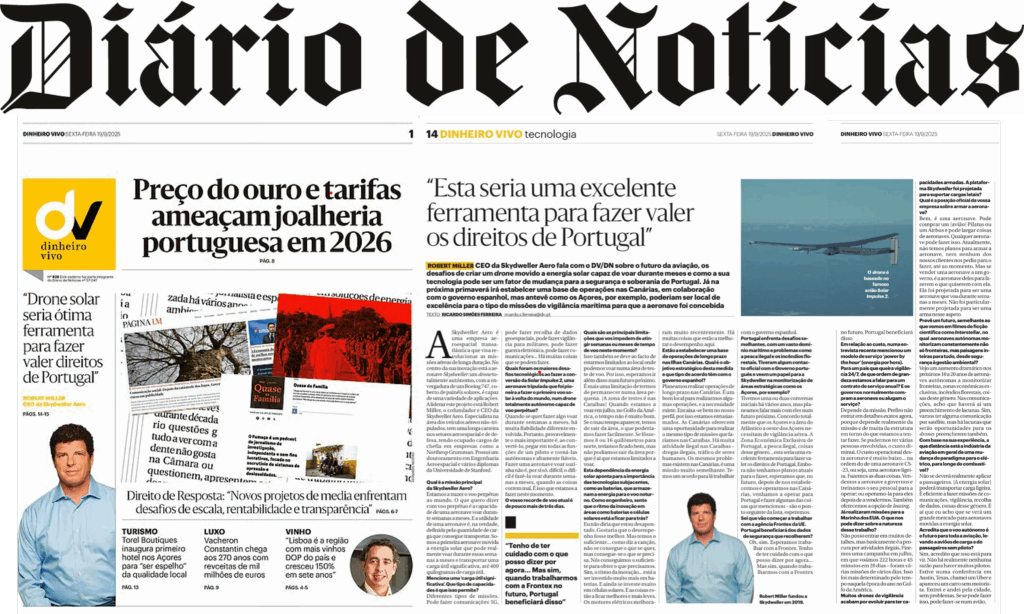
Skydweller Aero Featured in Portugal’s Leading Newspaper: Diário de Notícias
On September 19, 2025, Diário de Notícias — Portugal’s newspaper of record — published a feature on Skydweller Aero, highlighting its solar-powered autonomous aircraft and European operations. This recognition highlights the company’s growing role in Europe and its ability to deliver long-endurance solutions for maritime domain awareness, border protection, and security missions.
Pioneering Perpetual Flight®
The Skydweller aircraft is the first solar-powered, fully autonomous platform capable of flying for weeks to months at a time while carrying payloads of up to 400 kilograms. This makes Skydweller Aero central to missions such as illegal fishing prevention, environmental monitoring, disaster response, and 5G communications support.
As noted in the feature, “The Azores, for example, could serve as an excellent base of operations for the type of maritime surveillance missions our aircraft was designed for. This would be an excellent tool to assert Portugal’s rights.”
Strengthening European Partnerships
Skydweller Aero is preparing to establish a long-term operations base in the Canary Islands in partnership with the Spanish government. This hub will provide a foundation for persistent surveillance against smuggling and trafficking — missions already demonstrated in collaboration with the U.S. Navy.
Looking ahead, Skydweller Aero is expected to expand cooperation with European agencies such as Frontex, providing EU member states with access to affordable, persistent surveillance.
This recognition in Diário de Notícias underscores Skydweller Aero’s mission to pioneer Perpetual Flight® and redefine the future of autonomous aviation for Europe and beyond.
📖 Read the original article in Diário de Notícias; English and Portuguese text below.
🌍 Learn more about our missions and technology.
Interview with Skydweller Aero’s CEO in Portugal’s leading newspaper
DIÁRIO DE NOTICIAS
19 September 2025
“This would be an excellent tool to assert Portugal’s rights”
ROBERT MILLER, CEO of Skydweller Aero, talks to DV/DN about the future of aviation, the challenges of creating a solar-powered drone capable of flying for months, and how its technology could be a game-changer for Portugal’s security and sovereignty. Next spring, he will establish a base of operations in the Canary Islands, in collaboration with the Spanish government, but he envisions how the Azores, for example, could be an excellent location for the type of maritime surveillance missions for which the aircraft was designed.
Skydweller Aero is a transatlantic aerospace company aiming to revolutionize long-endurance aerial missions. At the heart of its innovation is the Skydweller aircraft, a fully autonomous drone with the wingspan of a Boeing 747, covered in solar panels, capable of a variety of applications.
Leading this project is Robert Miller, the co-founder and CEO of Skydweller Aero. An expert in unmanned aerial vehicles, he has a long career in the aerospace and defense sectors, having held senior positions at companies such as Northrop Grumman. He holds a doctorate in Aerospace Engineering and several degrees from Stanford University.
What is Skydweller Aero’s primary mission?
We are bringing perpetual flight to the world. What I mean by perpetual flight is the ability of an aircraft to fly for weeks to months. And the usefulness of an aircraft is actually defined by the amount of cargo it can carry. We are the first solar-powered aircraft that can actually fly for those weeks to months and carry a significant payload, up to 400 kilograms of payload.
You mention a ‘significant payload.’ What kind of capabilities does this enable? Different types of missions.
You can do 5G communications, you can do geospatial data collection, you can do military surveillance, you can do electronic warfare, you can do communications… There are many things you can do.
What were the biggest technological challenges in converting the Solar Impulse 2, a manned aircraft that pioneered the first solar flight around the world, into a fully autonomous drone capable of perpetual flight?
When you want to fly something for weeks or months, there are many different reliability considerations involved. Therefore, probably the most important thing when converting it is to take all the functions of a pilot and make them autonomous and highly reliable. Flying an aircraft alone isn’t, in itself, difficult; what’s difficult is flying it for weeks or months when things go wrong. And that’s what we’re doing right now.
Your current flight record is just over three days. What are the main limitations preventing you from achieving weeks or months of flight time at this point?
This is also due to the fact that we’re limited to where we can fly in a flight test area. So we hope to expand beyond that in the near future. It’s another limitation of having to stay in a small area. [The test area is in the Caribbean] When we’re flying in July in the Gulf of America, the weather isn’t very good. If bad weather hits, we have to leave the area, which we could easily do. If we were 8 or 16 kilometers north, we would have been fine, but we couldn’t leave the area because that’s where we’re limited to flying.
This reliance on solar energy highlights the importance of underlying technologies, such as batteries, which store energy for night flight. As an engineer, do you feel that the pace of innovation in areas like batteries and solar cells is lagging?
I wouldn’t say I’m disappointed. I wish the performance were better. But we have enough… as the song says, you can’t get what you want, but you get what you need. We get enough to get what we need. Yes, the pace of innovation… there’s a lot more investment being made in batteries. And there’s still a lot of investment in solar cells. And things are getting better and lighter. Electric motors have improved a lot recently. There are a lot of things that are improving performance here.
They are establishing a long-term operations base in the Canary Islands. What is the strategic objective of this measure, and what kind of agreement do you have with the Spanish government?
We plan to conduct long-term operations in the Canary Islands. It’s a good location for us to conduct some operations, and the need exists. It fits our profile well, so we’re excited. The Canary Islands offer an opportunity to conduct the same type of missions we would in the Caribbean. There’s a lot of illegal activity in the Caribbean—illegal drugs, human trafficking. The same problems exist in the Canary Islands; it’s a very similar mission. We have an agreement to work there with the Spanish government.
Portugal faces similar challenges, with a vast maritime domain and problems like illegal fishing and forest fires. Have you had any official contact with the Portuguese government, and do you see a role for Skydweller in monitoring strategic areas like the Azores, for example?
We had one or two initial conversations several years ago, but we plan to talk more with them in the near future. I completely agree that the Azores and the Atlantic area west of the Azores need aerial surveillance. Portugal’s Exclusive Economic Zone, illegal fishing, things like that… this would be an excellent tool for enforcing Portugal’s rights. While we have no current plans to do so, we hope that in the future, after establishing ourselves and operating in the Canaries, we will operate for Portugal and do some of the things you mentioned—they are next on the list, hopefully.
I know you’re going to start working with the EU’s Frontex agency. Will Portugal benefit from the security data they collect?
Oh, yes. We hope to work with Frontex. I have to be careful about what I say for now. But yes, when we work with Frontex. In the future, Portugal will benefit from this.
Regarding cost, in a recent interview you published a power-by-the-hour service model. For a country that wants 24/7 surveillance, what order of magnitude would we talk about for an annual service contract? And do governments typically purchase an aircraft or lease the service?
It depends on the mission. I’d rather not go into exact details right now, because it really depends on the mission and a lot on the structure around what we’re trying to accomplish. We can have several people involved, the cost of a minute. The operating cost of this aircraft is very low… on the order of a CS-23 aircraft, that is, a light aircraft. We do both. We sell aircraft to governments and train their personnel to operate them; or we operate them for them after selling them. We also offer leasing options.
You’ve flown missions for the US Navy. What can you tell us about the nature of this work?
I can’t go into too much detail, but it’s basically about tracking down illegal activity. We did a campaign in July where we flew 222 hours and 45 minutes in 20 days—several multi-day missions. This was largely determined by the weather at that time of year in the Gulf of America.
Many surveillance drones eventually evolve to have weaponized capabilities. Is the Skydweller platform designed to carry lethal payloads? What is your company’s official position on weaponizing the aircraft?
Well, it’s an aircraft. You can buy a Pilatus or an Airbus and you can drop things from aircraft. Any aircraft can do that. We currently have no plans to weaponize the aircraft, nor have any of our customers asked us to do so, so far. But if you sell an aircraft to a government, it’s their aircraft to do whatever they want with. It’s designed to be an aircraft that flies for weeks to months. It’s not particularly designed to be a weapon in that regard.
Do you foresee a future, similar to what we see in science fiction films like Interstellar, in which autonomous aircraft constantly monitor not just borders, but entire landscapes for everything from security to environmental management?
I see a dramatic increase in the next 10 to 20 years of autonomous aircraft monitoring borders, exclusive economic zones, forest fires, things like that. In communications, I think there will be a gap-filling there. Yes, we will have some satellite communication, but there are gaps that will be opportunities for drones to fill as well.
Based on your experience, how far is the aviation industry in general from a paradigm shift to electric, away from fuel?
It shouldn’t really apply to passengers. [Solar power] will be able to carry light cargo. And it will be efficient in doing communications, surveillance, data collection, things like that. That’s where I think you’ll see a big market for solar-powered aircraft.
Do you believe autonomous flight is the future for all aviation, leading to pilotless cargo and passenger planes?
Yes, I believe it’s coming. There’s really no reason for there to be too many pilots. I was at a conference in Austin, Texas, and I called an Uber and a driverless car showed up. I got in and drove around the city, no problem. If you can do that, you can do it in a plane.
Artigo sobre o Skydweller Aero
DIARIO DE NOTICIAS (Portugal)
19 de setembro de 2025
Tecnologia
“Esta seria uma excelente ferramenta para fazer valer os direitos de Portugal”
ROBERT MILLER CEO da Skydweller Aero fala com o DV/DN sobre o futuro da aviação, os desafios de criar um drone movido a energia solar capaz de voar durante meses e como a sua tecnologia pode ser um fator de mudança para a segurança e soberania de Portugal. Já na próxima primaverá irá estabelcer uma base de operações nas Canárias, em colaboração com o governo espanhol, mas antevê como os Açores, por exemplo, poderiam ser local de excelência para o tipo de missões de vigilância maritima para que a aeronave foi concebida
A Skydweller Aero é uma empresa aeroespacial transatlântica que visa revolucionar as missões aéreas de longa duração. No centro da sua inovação está a aeronave Skydweller um droneto-talmente autónomo, com a envergadura de um Boeing 747, coberto de painéis solares, é capaz. de uma variedade de aplicações.A liderar este projeto está Robert Miller, o cofundador e CEO da Skydweller Aero. Especialista na área dos veiculos aéreos não-tri-pulados, tem uma longa carreira nos setores aeroespacial e de de-fesa, tendo ocupado cargos de chetia em empresas como a Northrop Grumman. Possui um doutoramento em Engenharia Aeroespacial e vários diplomas da Universidade de Stanford.
Qual é a missão principal da Skydweller Aero?
Estamos a trazer o voo perpétuo ao mundo. O que quero dizer com voo perpétuo é a capacidade de uma aeronave voar durante semanas a meses. E a utilidade de uma aeronave é, na verdade. definida pela quantidade de carga que consegue transportar. Somos a primeira aeronave movida a energia solar que pode realmente voar durante essas semanas a meses e transportar uma carga útil significativa, até 400 quilogramas de carga útil.
Menciona uma ‘carga útil signi-ficativa. Que tipo de capacidades é que isso permite? Diferentes tipos de missões.
Pode fazer comunicações 5G, pode fazer recolha de dados geoespaciais, pode fazer vigilância para militares, pode fazer guerra eletrónica, pode fazer co-municações.. Há muitas coisas que se podem fazer.
Quais foram os maiores desafios tecnológicos ao fazer a conversão da Solar Impulse 2, uma aeronave tripulada que foi pioneira a fazer o primeiro voo solar à volta do mundo, num drone totalmente autónomo capaz de voo perpétuo?
Quando se quer fazer algo voar durante semanas a meses, há muita fiabilidade diferente en-volvida. Portanto, provavelmente o mais importante é, ao con-vertê-lo, pegar em todas as funções de um piloto e torná-las autónomas e altamente fiáveis. Fazer uma aeronave voar sozinha não é, por si só, dificil; o difi-cil é fazê-la voar durante semanas a meses, quando as coisas correm mal. E isso que estamos a fazer neste momento.
O vosso recorde de voo atualé de pouco mais de três dias. Quais são as principais limitações que vos impedem de atingir semanas ou meses de tempo de voo neste momento?
Isso também se deve ao facto de estarmos limitados ao local onde podemos voar numa área de teste de voo. Por isso, esperamos ir além disso num futuro próximo. É mais uma limitação de termos de permanecer numa área pe-quena. [A zona de testes é nas Caraíbas] Quando estamos a voar em julho, no Golfo da Amé-rica, o tempo não é muito bom. Se o mau tempo aparecer, temos de sair da área, o que poderíamos fazer facilmente. Se fösse-mos 8 ou 16 quilómetros para norte, teríamos ficado bem, mas não podiamos sair da área porque é aí que estamos limitados a voar.
Esta dependência da energia solar aponta para a importância das tecnologias subjacentes, como as baterias, que armaze-nama energia para o voo notur-no. Como engenheiro, sente que o ritmo da inovação em áreas como baterias e células solares está a ficar para trás?
Eu não diria que estou desapon-tado. Gostaria que o desempenho fosse melhor. Mas temos o suficiente… como diz a canção, não se consegue o que se quer, mas consegue-se o que se preci-sa. Nos conseguimos o suficiente para obter o que precisamos. Sim, o ritmo da inovação… está a ser investido muito mais em ba-terias. E ainda se investe muito em células solares. E as coisas estão a ficar melhores e mais leves. Os motores elétricos melhoraram muito recentemente. Há muitas coisas que estão a melho-raro desempenho aqui.
Estão a estabelecer uma base de operações de longo prazo nasilhas Canárias. Qual é o objetivo estratégico desta medida e que tipo de acordo têm com o governo espanhol?
Planeamos realizar operações de longo prazo nas Canárias. Eum bom local para realizarmos algumas operações, e a necessidade existe. Encaixa-se bem no nosso perfil, por isso estamos entusias-mados. As Canárias oferecem uma oportunidade para realizar o mesmo tipo de missões que faríamos nas Caraíbas. Há muita atividade ilegal nas Caraibas – drogas ilegais, tráfico de seres humanos. Os mesmos problemas existem nas Canárias, é uma missão muito semelhante. Temos um acordo para lá trabalhar com o governo espanhol.
Portugal enfrenta desafios semelhantes, com um vasto domi-nio maritimo e problemas como a pesca ilegal e os incêndios flo-restais. Tiveram algum contac-to oficial com o Governo português e veemumpapel paraa Skydweller na monitorização de áreas estratégicas como os Açores, por exemplo?
Tivemos uma ou duas conversas iniciais há vários anos, mas planeamos falar mais com eles num futuro próximo. Concordo totalmente que os Açores e a área do Atlântico a oeste dos Açores necessitam de vigilância aérea. A Zona Económica Exclusiva de Portugal, a pesca ilegal, coisas desse género… esta seria uma excelente ferramenta para fazer valer os direitos de Portugal. Embora não tenhamos planos atuais para o fazer, esperamos que, no futuro, depois de nos estabelecermos e operarmos nas Canárias, venhamos a operar para Portugal e fazer algumas das coisas que mencionou – são o ponto seguinte da lista, esperemos.
Sei que vão começar a trabalhar comaagência Frontex da UE. Portugal beneficiará dos dados de segurança que recolherem?
Oh, sim. Esperamos trabalhar com a Frontex. Tenho de ter cuidado com o que posso dizer por agora… Mas sim, quando trabalharmos com a Frontex no futuro, Portugal beneficiará disso.
Em relação ao custo, numa entrevista recente mencionou um modelo de serviço power by the hour’ (energia por hora).
Para um país que queira vigilância 24/7, de que ordem de grandeza estamos a falar para um contrato de serviço anual? E os governos normalmente compram a aeronave ou alugam o serviço?
Depende da missão. Prefiro não entrar em detalhes exatos agora, porque depende realmente da missão e de muita da estrutura em torno do que estamos a tentar fazer. Se pudermos ter várias pessoas envolvidas, o custo di-minui. O custo operacional desta aeronave é muito baixo… na ordem do de uma aeronave CS-
-23, ou seja, uma aeronave ligei-ra. Fazemos as duas coisas. Vendemos a aeronave a governos e treinamos o seu pessoal para a operar; ou operamo-la para eles depois de a vendermos. Também oferecemos a opção de leasing.
Járealizaram missões para a Marinha dos EUA. O que nos pode dizer sobre a natureza desse trabalho?
Não posso entrar em muitos de-talhes, mas basicamente é a procura por atividades ilegais. Fizemos uma campanha em julho, em que voámos 222 horas e 45 minutos em 20 dias – foram várias missões de vários dias. Isso foi mais determinado pelo tempo naquela época do ano no Golfo da América.
Muitos drones de vigilância acabam por evoluir para ter capacidades armadas. A plataforma Skydweller foi projetada para suportar cargas letais? Qual é a posição oficial da vossa empresa sobre armar a aerona-ve?
Bem, é uma aeronave. Pode comprar um [avião] Pilatus ou um Airbus e pode largar coisas de aeronaves. Qualquer aeronave pode fazer isso. Atualmente, não temos planos para armar a aeronave, nem nenhum dos nossos clientes nos pediu para o fazer, até ao momento. Mas se vender uma aeronave a um go-verno, é a aeronave deles para fazerem o que quiserem com ela.
Ela for projetada para ser uma aeronave que voa durante semanas a meses. Não foi particularmente projetada para ser uma arma nesse aspeto.
Prevê um futuro, semelhante ao que vemos em filmes de ficção científica como Interstellar, no qual aeronaves autónomas mnitorizam constantemente nลือ só fronteiras, mas paisagens inteiras para tudo, desde segurança à gestão ambiental?
Vejo um aumento dramático nos próximos 10 a 20 anos de aeronaves autónomas a monitorizar fronteiras, zonas económicas ex-clusivas, incêndios florestais, coisas deste género. Nas comunica-ções, acho que haverá aí um preenchimento de lacunas. Sim, vamos ter alguma comunicação por satélite, mas há lacunas que serão oportunidades para os drones preencherem também.
Com base na sua experiência, a que distância está a indústria da aviação em geral de uma mudança de paradigma para o elé-trico, para longe do combustí-vel?
Não se deverá realmente aplicar a passageiros. [A energia solar] poderá transportar carga ligeira. E eficiente a fazer missões de co-municações, vigilância, recolha de dados, coisas desse género. É aí que eu acho que se verá um grande mercado para aeronaves movidas a energia solar.
Acredita que o voo autónomo é o futuro para toda a aviação, levando a aviões de carga e de passageiros sem piloto?
Sim, acredito que isso está para vir. Não há realmente nenhuma razão para haver muitos pilotos. Estive numa conferência em Austin, Texas, chamei um Uber e apareceu um carro sem motoris-ta. Entrei e andei pela cidade, sem problemas. Se se pode fazer isso, pode fazer-se num avião.